Chapter 01: Mapping the Terrain: How Disability Inclusion is Structured in India
Every landscape is shaped twice: once by what
exists on the ground, and once by what a society
has learned to notice. Disability inclusion in India
has been shaped across many sites at once:
census data, medical certification, welfare
schemes, court orders, school admissions,
workplace practices, family care, and the
everyday work of civil society. These are part
of the machinery through which inclusion is
enabled, delayed, negotiated, or denied.
This is the first clue that disability inclusion is
a systems question. It is located only in law,
service delivery, or individual experience, and
in the relationship between them: how people
move through institutions, how support is made
available, and how responsibility is distributed
when systems do not align.
Scale is one of the first places where this relationship becomes visible. Globally,
the World Health Organization estimates that 1.3 billion people, or around 16% of
the world’s population, experience significant disability. In India, official estimates
remain much lower: Census 2011 recorded 2.68 crore persons with disabilities, or
2.21% of the population, and the NSS 76th Round estimated disability prevalence at
2.2%. These differences shape who is counted, who can claim support, and whose
needs are planned for. Measurement, in this sense, helps define the boundaries of
public responsibility.1
In India, official estimates remain much lower: Census 2011 recorded 2.68 crore persons with disabilities, or 2.21% of the population, and the NSS 76th Round estimated disability prevalence at 2.2%.
The formal architecture of disability inclusion has also changed over the past
decade. The Rights of Persons with Disabilities Act, 2016 expanded recognized
disability categories, introduced reasonable accommodation, and placed clearer
obligations on government establishments and institutions. Recent judicial
developments have widened this frame further, affirming disability inclusion as a
question of access, dignity, and public responsibility rather than charity, discretion,
or individual adjustment.2
These shifts matter because they alter the terms on which persons with
disabilities can make claims, and the terms on which institutions can be held
to account. Yet access is still shaped through many ordinary points of contact:
securing certification, navigating entitlements, entering school, requesting
accommodation, accessing transport, using digital systems, finding responsive
officials, and sustaining support through families, caregivers, or nonprofit workers.
Across education, employment, healthcare, social protection, infrastructure, and
civic participation, inclusion turns on whether systems have imagined persons with
disabilities as ordinary users, learners, workers, and citizens.

When these assumptions do not match people’s lives, the work of access shifts onto persons with disabilities and those closest to them.
Families compensate for inaccessible services. Women and girls carry disproportionate unpaid care. Persons with disabilities living at the intersections of poverty, caste, gender, rurality, and age face additional barriers to recognition and support that compound in ways most schemes are not designed to reach. Civil society organizations step in, not only as service providers, but as translators, navigators, advocates, trust-builders, and holders of continuity across fragmented systems.
This is why disability inclusion is a structural question. It asks how access is designed, who carries the burden of navigation, what forms of support are treated as essential, and why disabled lives are still so often required to justify their claim to ordinary participation. The economic case is significant: excluding persons with disabilities from the labor market can cost countries between 3% and 7 % of GDP.3 But the deeper question is civic and institutional: whether systems built in the name of the public are prepared to serve the full diversity of the public.
The economic case is significant: excluding persons with disabilities from the labor market can cost countries between 3 % and 7 % of GDP.3
This chapter lays the foundation for the report. It situates disability inclusion within the human continuum; traces how India’s legal, policy, and institutional landscape has evolved; identifies why access remains uneven; and locates the actors working across this field. The rest of the report builds from this starting point, examining how nonprofits hold continuity where systems fragment, where exclusion repeats across domains, how funding shapes what is possible, and what collective action is required for disability inclusion to become durable.
1.1 How to Read This Report
Disability inclusion is a cross-cutting development imperative. However, it is often approached through visible failure: a child pushed out of school, a job applicant screened out, a pension denied, or a building constructed as unusable. While these are important entry points, they do not fully explain how such outcomes are produced. Therefore, in this report, we approach them as outcomes generated within a wider terrain, shaped by policy, institutional design, budget priorities, administrative practice, alongside social norms and uneven state capacity. Three analytical lenses organize our inquiry:
-
Lifecycle Lens:
Exclusion accumulates across the lifecycle, from early identification through schooling, skilling, employment, social protection, and into old age. Disability inclusion emerges as a priority long before employment and extends well beyond formal schooling. A child not identified early, or unsupported in school, is disproportionately likely to face exclusion from higher education, work, and income security. This lens also disrupts the notion of disability as a fixed or bounded identity. Individuals may experience disability at different moments, through birth, illness, accident, or aging. It allows for inclusion to be seen as the foundational condition that must be embedded continuously across the lifecycle. -
Systems Lens:
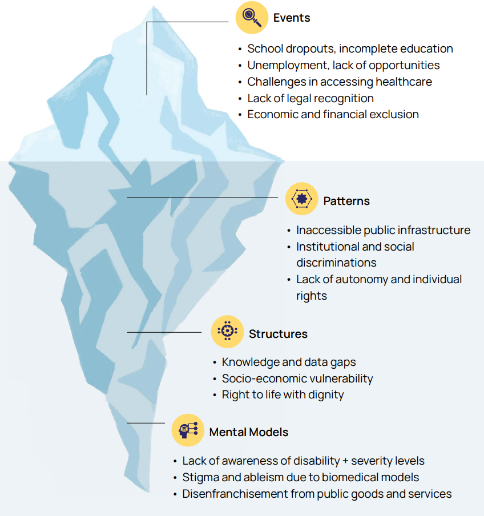
Here, the focus shifts from when exclusion occurs to why it persists. It recognizes that outcomes such as school dropout, unemployment, or barriers to healthcare are not merely discrete events, but visible expressions of deeper structural constraints. These include inaccessible physical and digital infrastructure, fragmented and siloed service delivery systems, institutional practices that exclude by design, and pervasive social norms shaped by ableism and stigma. Addressing the surface without addressing the roots produces gains that are inherently limited and difficult to sustain. -
Intersectionality Lens:
This helps understand how disability aggravates the lived experience in a socioculturally complex country such as India. Gender, caste, class, geography, and age shape how impairment is experienced and how institutions respond to it. Women with disabilities face specific vulnerabilities in safety, education, and economic participation. Persons from Scheduled Caste, Scheduled Tribe, and Other Backward Class communities with disabilities encounter layered disadvantages that standard disability schemes rarely address. Rural and low-income households bear disproportionate care burdens when public systems fail.
Together, these lenses allow the report in moving from isolated outcomes to a patterned explanation. Rather than reducing the analysis to a form of impairment, the report keeps in view the breadth of disability as recognized under the Rights of Persons with Disabilities (RPwD) Act, 2016 – and beyond. The breadth is necessary because exclusion is produced by systems built for a narrow idea of the ‘normal’ user, learner, worker, or citizen.7
1.2 How the Terrain of Disability Inclusion was Assembled
The disability ecosystem in India has been assembled over time, through policy, law, and society. Understanding why the system behaves as it does today require tracing how these layers came together.
1.2.1 From Charity to Rights: The Long Shift in Disability Framing
Before disability was framed in terms of rights, it was addressed primarily through a
combination of state welfare, philanthropy, family responsibility, and rehabilitationoriented services. In pre-Independence India, services were limited: typically
operated by voluntary organizations, a small number of special schools for blind
and deaf children, and institutions linked to care or custodial management.
Disability, particularly intellectual and psychosocial disability, was largely managed
within the household, with families bearing primary responsibility of care, income,
and everyday functioning.
8
Post-Independence policy did not fully overcome this tendency to privatize
disability. The constitutional promise of equality and social justice opened
some space for change, but for many years disability remained within a welfarerehabilitation frame rather than a citizenship frame.9 Persons with disabilities were
positioned as recipients of care rather than as people entitled to shape institutions
on equal terms.
The turn towards a rights-based approach emerged gradually, through both political
and institutional change.10 Disability rights movements in India developed alongside
other postcolonial struggles over equality and citizenship, challenging models
that treated disability as a matter of sympathy rather than justice. The Persons
with Disabilities (Equal Opportunities, Protection of Rights and Full Participation)
Act, 1995 marked a major turning point, moving the policy conversation beyond charity to include education, employment, non-discrimination, affirmative action,
and social security.11 At the same time, many of its provisions remained qualified by
the state’s “economic capacity and development,” allowing rights to be mediated
through administrative and fiscal discretion.12
1.2.2 International Anchors and Domestic Deepening: How Rights Frameworks Expanded
The 2000s brought another shift. The National Policy for Persons with Disabilities,
2006 broadened the framing of inclusion to encompass equal opportunity and
participation. More consequentially, India’s ratification of the United Nations
Convention on the Rights of Persons with Disabilities (UNCRPD) in 2007 placed
domestic policy within a stronger international framework, reinforcing expectations
around non-discrimination, accessibility, participation, and accountability.
13
This trajectory culminated in the Rights of Persons with Disabilities Act, 2016, the
central legal anchor of the current terrain. In addition to replacing earlier legislation,
the Act redefined the scope of disability inclusion. It expanded recognized
disability categories from seven to twenty-one, strengthened equality and dignity
provisions, mandated reasonable accommodation, broadened inclusive education
and employment obligations, and embedded accessibility across physical spaces,
transport, and information systems. It also established a more formal architecture,
with designated authorities and responsibilities across levels of government.
Even so, the disability ecosystem cannot be understood through the RPwD Act
alone. The Rehabilitation Council of India Act, 1992 established a framework for
the training of rehabilitation professionals, while The National Trust Act, 1999
created a statutory body focused on specific disability groups. These laws and
their trajectories suggest that disability inclusion has always depended not only on
legislative frameworks, but on professional capacity, administrative specialization,
inter-ministerial coordination, and local institutional presence.
1.2.3 Expansion Across Domains: How Disability Moved Beyond Disability-Specific Policy
Over time, disability spread into policy domains not originally framed as disabilityspecific. Accessibility became a national agenda through the Accessible India
Campaign (Sugamya Bharat Abhiyan), bringing built environments, transport, and
ICT into a framework of universal access. Education policy incorporated Children
with Special Needs within Samagra Shiksha, while social protection systems expanded to include pension schemes, assistive devices, and targeted support.
More recently, digital governance brought web accessibility, digital identity,
grievance reporting, and accessible information formats into the inclusion agenda.
The Union Budget 2026–27 further signaled strategic intent, enabling skilling,
entrepreneurship, digital learning, and assistive technology for persons with
disabilities.14
This is why disability inclusion in India is better understood as the formation of
a terrain rather than the accumulation of laws or schemes. As the meaning of
disability has evolved, so have the institutions, expectations, and responsibilities
attached to it. The growth has been uneven and incomplete, but it has reshaped
what can now be demanded of the state, markets, and civil society — and it explains
why the terrain behaves the way it does today
1.3 Why Inclusion Remains Uneven
A stronger framework for equity has not necessarily translated into consistent outcomes. The evidence is unambiguous. The UDISE+ 2024–25 report records more than 2.14 million children with special needs enrolled in school, yet only 36% of schools have the facilities and infrastructure designed for them, and only 55% have ramps with handrails.15 Current observations on the systems in India, point to challenges regarding procedural delays, accessibility, and the current availability of disability-disaggregated data for tracking accountability. Three structural tensions help explain the unevenness in the landscape.
In India, The UDISE+ 2024–25 report records more than 2.14 million children with special needs enrolled in school, yet only 36% of schools have the facilities and infrastructure designed for them, and only 55% have ramps with handrails
1.3.1 Design Mismatch: Systems Built Around a Narrow Norm
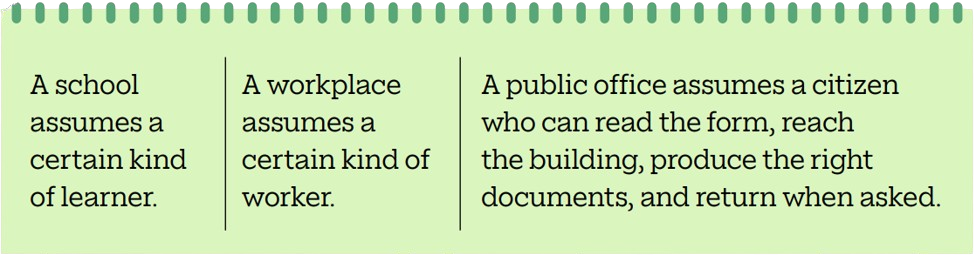
The most immediate source of unevenness is the mismatch between the diversity of disability and the uniformity of most institutional design. Schools, hospitals, workplaces, transport systems, and digital platforms were built around a narrow idea of the standard user. When a person’s body, communication style, pace of learning, or cognitive profile does not fit that norm, the system produces exclusion through the accumulated effect of inaccessible infrastructure, under-equipped service providers, and incomplete accommodations. The gap between what persons with disabilities need and what public services are designed to deliver is widest where design has been least informed by the people it is meant to serve.
1.3.2 State Variation: Uneven Institutional Capacity
Health, education, and social welfare are concurrent or state subjects under India’s constitutional framework. While central legislation may establish rights, implementation depends on state-level capacity and priorities. Whether the RPwD Act translates into meaningful access hinges on the functionality of state commissioner’s offices, teacher training in inclusive design, accessibility standards, and procurement processes. Variation across states in all these dimensions is wide and well-documented.16 Unlike issues where concentrated harms generate clear pressure, the costs of disability exclusion are dispersed among households, unpaid care, interrupted education, and lost income. These are less legible to data systems that do not collect disaggregated information, and less easily attributed to specific institutional outcomes.
1.3.3 Shared Stakes: Building Coordination Across Institutions and Sectors
Disability inclusion spans multiple domains – education, health, labor, social
justice, rural development, transport, housing, and digital infrastructure. And
coordination among these sectors remains limited. Schemes may be well-designed
in one ministry and unimplemented in another. Individuals navigating entitlements
may encounter four different departments with incompatible documentation
requirements, separate grievance mechanisms, and different implementation
timelines.17
This fragmentation reflects the need for greater alignment and coordination to
overcome institutional silos, by centering everyday contexts of disability. Closing
the distance between the promise of inclusion and what institutions deliver on the
ground requires both coordination and compliance.
1.4 Making the System Visible
A person does not experience disability in one sector at a time. Their life may involve early diagnosis in the health system, schooling in mainstream or special settings, skill training, attempts to secure employment, recourse to social protection, negotiation of public transport, use of assistive technology, and interaction with digital public infrastructure. Each of these sites can either widen or narrow participation. And at each site, the same structural tensions play out.

1.4.1 The Domains of Inclusion: Where Participation is Made and Unmade
The terrain of disability inclusion spans at least five domains, each with its own actors, logic, and failure modes.
-
Education is where trajectories are set, often before anyone has named what is happening. It is a powerful cascade, beginning from a missed developmental marker, a delayed referral, a classroom that cannot accommodate differences, a teacher who mistakes disability for low intelligence. By the time a child reaches adolescence without appropriate support, years of compounding disadvantage have already narrowed what remains possible. And yet, the gap between early identification in principle and early identification in practice remains wide.
-
Employment is where earlier disadvantage either hardens into exclusion or, occasionally, can be interrupted. Skilling programs frequently carry the imprint of what employers are expected to want, which often reflects assumptions about who is "trainable" and for what. Labor markets, meanwhile, are structured around physical and communicative norms that treat departure from them as a problem to be managed rather than a diversity to be designed for.
-
Health systems are typically where institutional contact begins — and where so much is decided before the rest of the system becomes relevant. Diagnostic accuracy, early intervention, and rehabilitation support are unevenly available across geographies, frequently missing in secondary and tertiary towns and in primary care settings that lack specialist capacity.
-
Legal and civic life speaks to how policy mandates and social protections shape inclusion. Courts, grievance redressal channels, and disability commissioners are, at their best, the architecture that gives other commitments teeth. This is characteristically slow, expensive, and inaccessible to many of those it is meant to serve, and more effective for those with resources to sustain complaints over time.
-
Social participation is where the cumulative effects of exclusion across other spheres of life register most concretely, in who is present within public life and who is not. It encompasses movement through shared spaces, civic engagement, and the degree to which people with disabilities are imagined as ordinary participants in community life, rather than exceptions to it.
A person does not experience disability in one sector at a time. Their life may involve early diagnosis in the health system, schooling in mainstream or special settings, skill training, attempts to secure employment, recourse to social protection, negotiation of public transport, use of assistive technology, and interaction with digital public infrastructure. Each of these sites can either widen or narrow participation. And at each site, the same structural tensions play out.
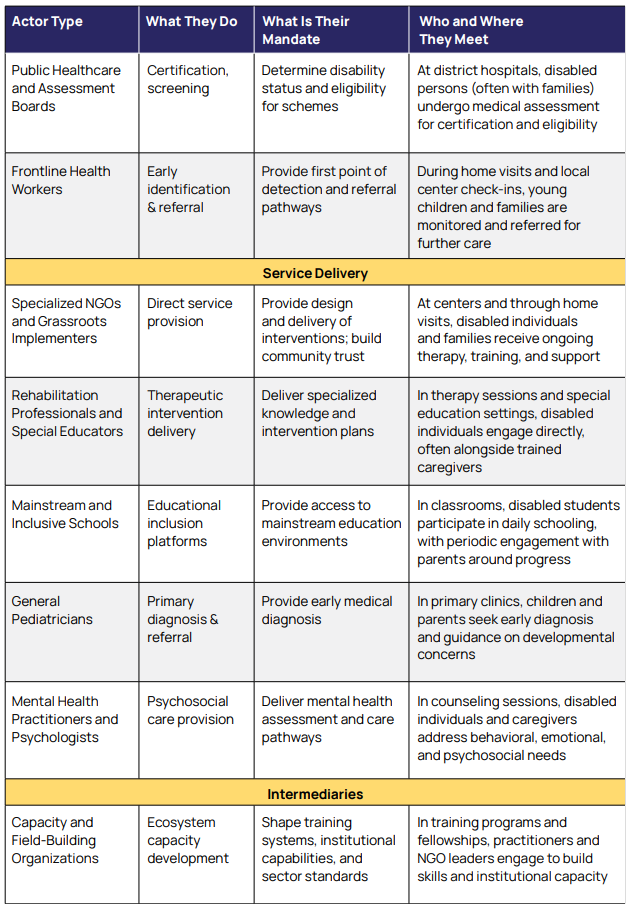
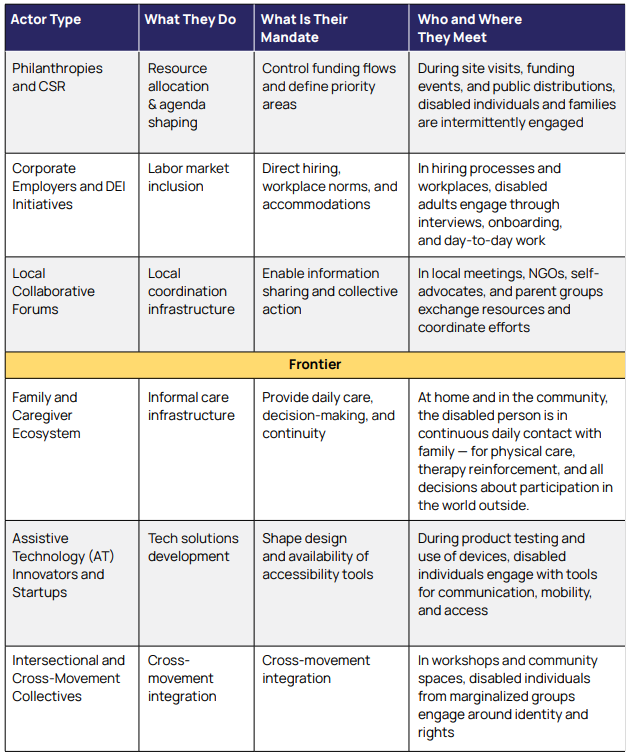
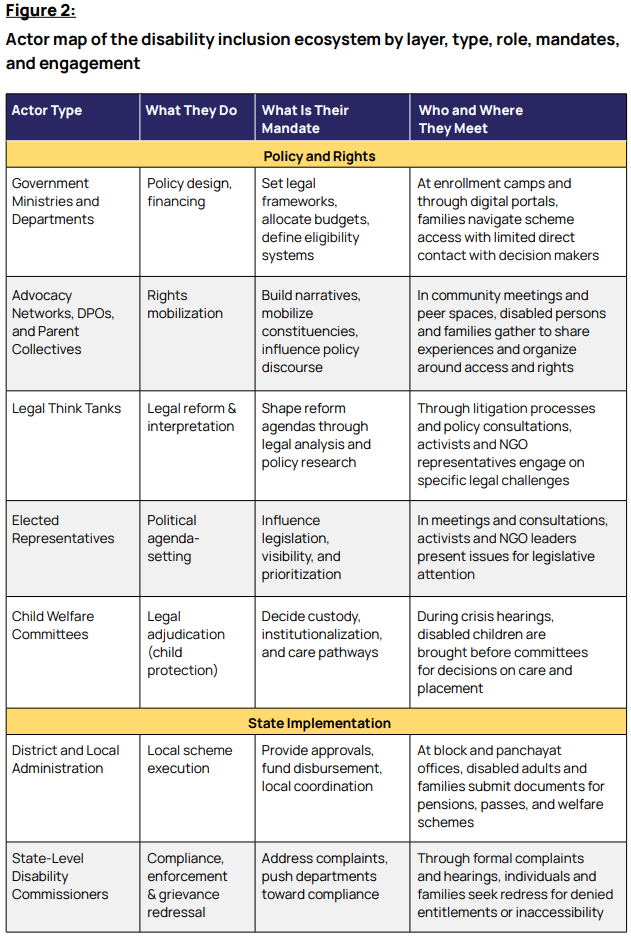
1.5 Who Makes the Ecosystem Function
The ecosystem is experienced through sites like block offices, hospital assessments, and classrooms by people with disabilities in India. Behind every policy mandate and delivery gap is a set of actors whose decisions and span of influence determine what inclusion can look like. The table below maps the actors in this ecosystem, sketching out a picture of where leverage and influence sit, how they move, and what helps them reach the communities they serve.