Chapter 04. Strengthening the Ecosystem: Capital, Capacity, and the Conditions for Durable Action
Nonprofits sustain continuity across systems, extending beyond their mandates to keep access, care, and participation from collapsing. Strengthening this ecosystem, therefore, cannot be understood as a question of scale alone. It is as much a question of what kinds of work the current architecture is able to sustain, and what it continues to defer. This chapter follows two forces shaping the nonprofit ecosystem today: funding flows and capacity
4.1 How Philanthropic Capital Shapes the Ecosystem
Funding plays a critical role in shaping India’s disability ecosystem, explaining why
certain forms of work flourish, others stall, and some never find room to exist at
all. This defines the stakes around how philanthropic capital enters and moves
through the nonprofit ecosystem, within a broader funding context that is already
constrained.
India’s overall social sector funding landscape, including private philanthropy, CSR,
and government spending61 has expanded significantly in recent years, reaching
roughly INR 27 lakh crore in FY25 and growing at a 13% CAGR since FY20, with public
spending accounting for about 95% of the total. While growth is promising, it is
insufficient in relation to the sectoral needs. The overall funding shortfall to meet
the Sustainable Development Goals, stands at approximately INR 16 lakh crore in
FY25 and is projected to widen further by FY30. Disaggregated data on disabilityspecific philanthropic flows to India remains scarce. Based on proxy data available
via the National CSR Portal, disability commands a marginal share in India’s
philanthropic landscape.
But the challenge goes beyond underfunding; it is also driven by the diversity of
funder mandates, timelines, and constraints — shaping what kinds of work find
support, and what remains harder to sustain. This section examines how different
streams of capital enter the disability ecosystem, what kinds of work they are
structured to support, and what this architecture implies for the field as a whole.
4.1.1 Funding Streams and Logics: Who Funds What, and Why
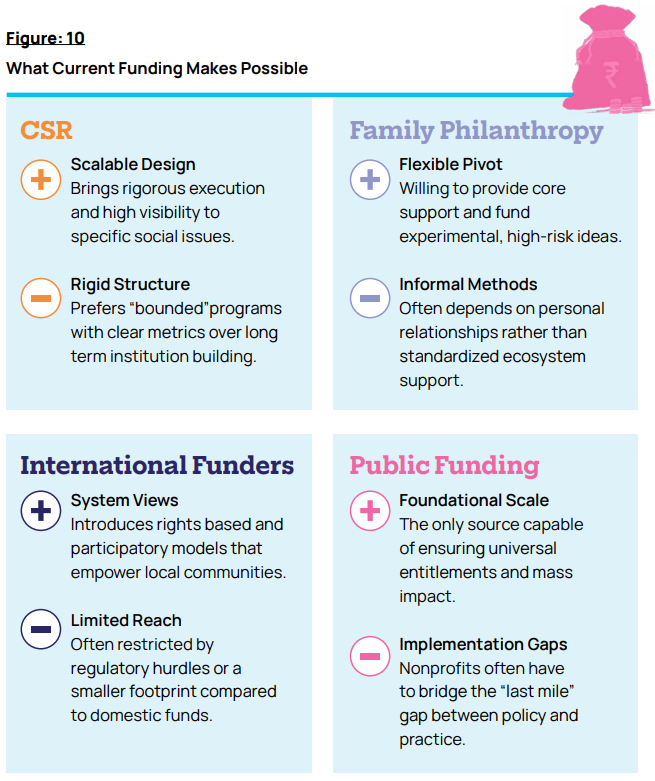
Philanthropic capital moves through the disability ecosystem through a set of distinct actors, CSR, family philanthropy, international funders, and the state, each shaping what kinds of work it is able to support. At the broadest level, disability remains underfunded globally. Even as the language of inclusion has expanded, resource allocation has not kept pace – estimates suggest that disability inclusion receives less than 2% of global development funding.62 This wider imbalance matters because it places disability within a funding environment where recognition has grown faster than commitment.
CORPORATE SOCIAL RESPONSIBILITY
The National CSR Portal classifies spending by sector. Disability inclusion is grouped
under the broader category of 'Education, Differently Abled, and Livelihood', making
it difficult to isolate disability-specific figures precisely. However, the reporting
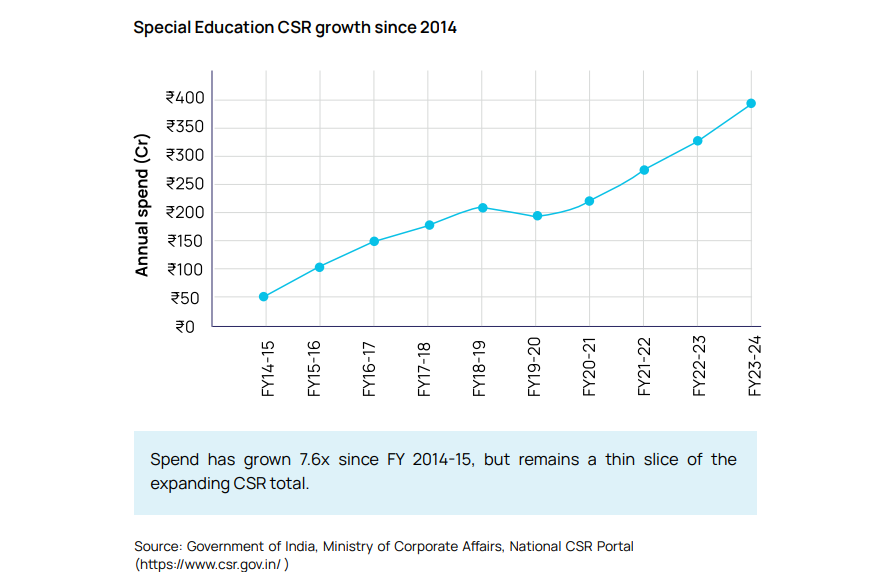
undertaken for FY 23-24, for the sub-head of ‘Special Education,’ offers preliminary
insights about the state of funding.
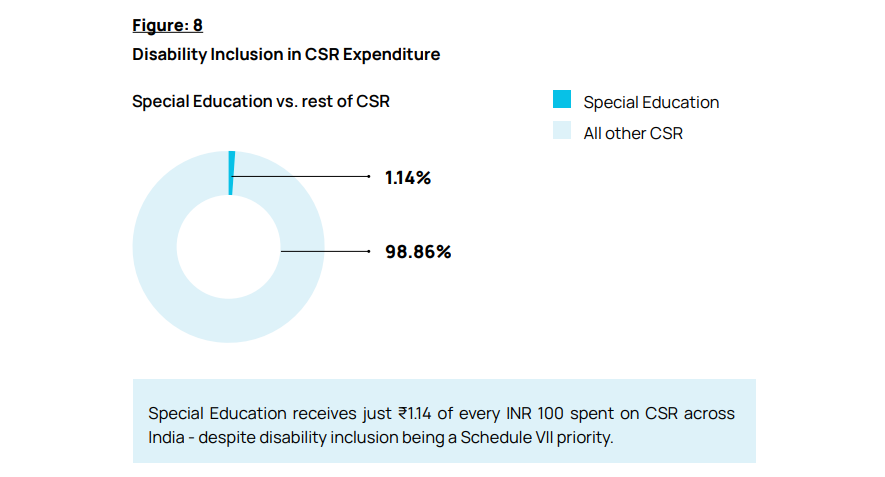
Special Education received just 1.14% of total CSR spending in FY 2023–24 i.e.,
INR 396.57 crore out of INR 34,908.75 crore. This a small slice for a sub-category
serving one of India's most underserved populations.The participation gap is
equally notable. Only 1,182 of 27,188 eligible companies, about 4.35%, directed any
funds to Special Education at all. It can be assumed that many companies either
chose not to engage with this sub-category or folded disability-related giving into
other buckets (like vocational training or healthcare) that wouldn't appear here.
The average spend per company in Special Education (INR 33.5 lakh) is also
considerably lower than the all-CSR average of INR 1.28 crore per company,
suggesting that when companies do engage, they tend to treat it as a
supplementary rather than primary giving area. The top 10 companies alone drive
nearly a quarter of all Special Education CSR, which points to how dependent this
sub-sector is on a handful of motivated corporate champions rather than broadbased participation.
There are, however, examples of corporates beginning to work through deeper and more sustained partnership models. Bajaj Finserv’s disability-focused initiatives and Tech Mahindra Foundation’s lifecycle approach to disability inclusion demonstrate how CSR can move beyond one-off support toward longer-horizon engagement with implementation partners and institutions.64 65
FAMILY AND INDIVIDUAL PHILANTHROPY
In India, family philanthropy has emerged as a significant and growing part of giving, accounting for almost a third of domestic private contributions and expanding steadily over recent years. Family and individual philanthropy often operate with greater flexibility, supporting areas such as core funding, organizational growth, early-stage experimentation, and slower forms of institutional work. In a sector where not all essential functions can be cleanly bounded as programs, this difference matters greatly. Investments with the potential to be far-reaching and enduring in their mandate, such as building evidence, shifting narratives and practice, and developing replicable models, rarely produce legible outputs within a time-bound quarterly or annual grant window. Sustaining such work demands long-term engagement and a high appetite for innovation among funders, which family philanthropy is uniquely positioned to drive.
Nonetheless, such investments are still to catch up with the massive deficits, and are often dispersed and relationship-driven, with fewer mechanisms for coordinated, long-term ecosystem deployment. Harnessing family and individual philanthropy to support work that is slower, less visible, or harder to fit within narrower grant structures remains an important opportunity to build greater coherence at the level of the field.
International funders have played an important role in advancing rights-based approaches, research, and movement-building within the disability ecosystem.
INTERNATIONAL FUNDERS
International funders have played an important role in advancing rights-based approaches, research, and movement-building within the disability ecosystem. Their contribution is often as normative as it is financial, widening how the field is funded and what it treats as fundable. This support takes several forms: core and flexible funding from disability-focused funds and private philanthropies, programmatic investments from multilaterals and disability inclusion INGOs, and niche grants from organizations working on particular conditions or interventions. International funding has played a key role in seeding participatory grantmaking approaches, intersectional practice, and systemic change – precisely the areas where domestic funding has historically lagged
Their presence in India, however, remains limited relative to the scale of the field, and concentrated among organizations with the institutional capacity to engage at that level. In practice, this has meant that international funders often partner with larger organizations that can convene and resource hyperlocal actors that are closer to the ground. The support has deepened parts of the ecosystem but has not shifted the wider imbalance in how disability is funded.
THE STATE
The primary central government body responsible for disability welfare is the Department of Empowerment of Persons with Disabilities (DEPwD), which sits within the Ministry of Social Justice and Empowerment (MSJE). The table below traces DEPwD budget allocations over recent years.
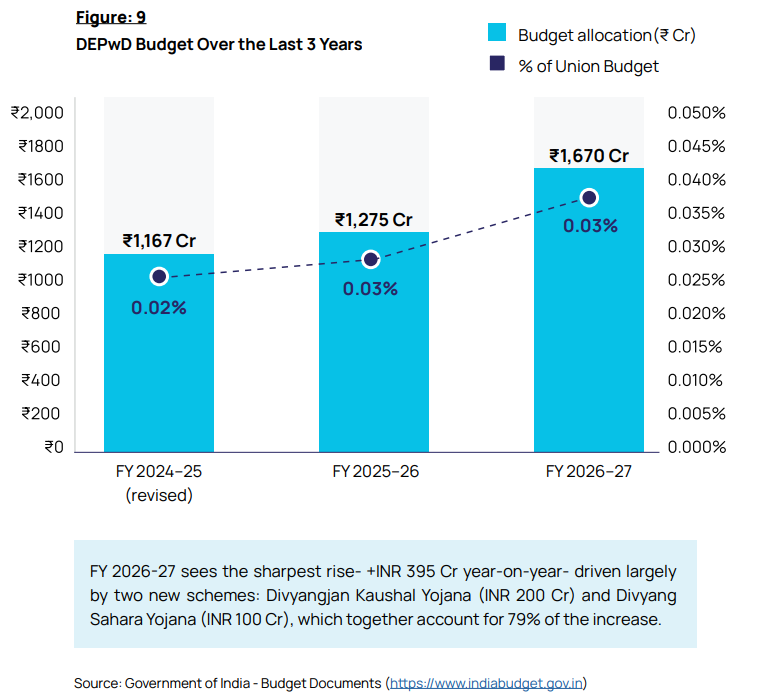
The FY 2026–27 allocation of INR 1,670 crore represents a significant nominal
increase, approximately 30% over revised estimates for 2025–26.68 However, two
new schemes account for the bulk of this rise: the Divyangjan Kaushal Yojana (INR
200 crore, focused on industry-aligned skill development) and the Divyang Sahara
Yojana (INR 100 crore, for assistive devices). Together, these two new schemes
make up around 79% of the year-on-year increase, while funding for existing
institutional and administrative programs has grown only marginally. A lack of upto-date estimates of disability prevalence makes it challenging to map how DEPwD
budget allocations sit alongside coverage requirements.
Public funding is foundational in principle, moving through schemes, entitlements,
and welfare infrastructure that remain key to how disability support is delivered
at scale. It sets the baseline architecture within which all other funding streams
operate. Where state systems are more coherent, they demonstrate that
entitlements must exist through funding, implementation, and access in practice.
In addition to administrative complexity and regional variation, inter-departmental
coordination emerges as a bottleneck in resources reaching the ground. Beyond
the MSJE, central ministries working on critical issues like housing and rural
development often lack dedicated resources for disability inclusion. Coordination
between central and state government departments can also dictate how
resources flow towards mandates. For nonprofits, public funding is rarely separable
from the translation and follow-through that must accompany it.
These four streams of funding for disability inclusion in India function more like
distinct, sometimes intersecting systems operating in the same landscape, rather
than a cohesive ecosystem. Each operates through its own internally coherent,
sometimes institutionally defined logic, but often ends up working in silos. The
result is a landscape where work that falls neatly within a single funding stream's
logic is likelier to draw resourcing. The funding architecture required to sustain
large-scale efforts that require multiple streams to align, such as coordination,
field-building, long-horizon institutional development, remains nascent. The
characteristics of each funding stream elucidate, in aggregate, what reaches
whom and where
The FY 2026–27 allocation of INR 1,670 crore represents a significant increase, approximately 30% over revised estimates for 2025–26.
4.1.2 What Philanthropic Capital Reaches, and What It Misses
At the last mile, disability inclusion is made or unmade in everyday settings — where individuals and families must move through schools, health systems, documentation processes, livelihoods pathways, and local institutions to access what formally exists. Beyond whether or not a solution is available, it matters whether support can travel across these touchpoints in ways that remain usable, continuous, and responsive to lived needs.
THE VISIBLE CORE: WORK THAT IS EASY TO FUND
Current funding structures reach some parts of this work more easily than others. Our survey data showed that nonprofits’ work is concentrated in areas that are easier to define and support as standalone interventions: inclusive and special education (63%), livelihoods and workforce inclusion (48%), early intervention (42%), and healthcare, rehabilitation, and therapy (40%). Beyond these, the distribution dropped sharply. Research and evidence building accounted for 8% of organizations, caregiver support 8%, legal aid and documentation 7%, narrative change and advocacy 7%, mental health and psychosocial support 10%, and accessibility around 6%.
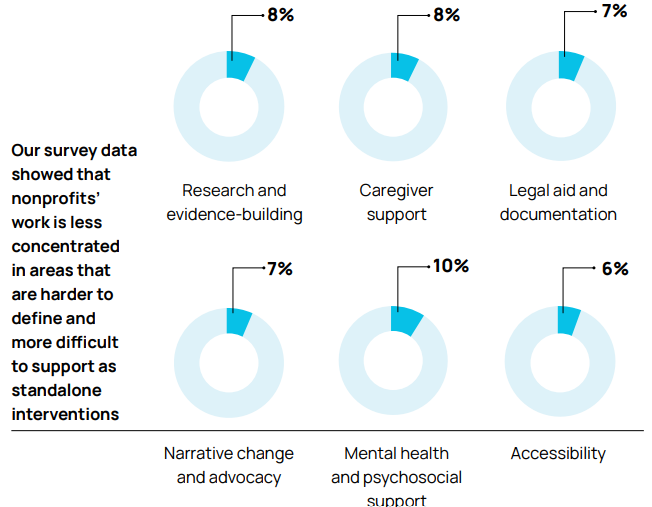
This pattern illustrates how thinner areas can be harder to articulate and stabilize within prevailing funding logics. Education, therapy, and skilling can be structured as programs with clear outputs. Caregiver support, legal navigation, accessibility, research, and advocacy sit closer to the enabling edge of the ecosystem. They make interventions usable and durable, but do not always present themselves as discrete programs. As Prashant Sude from GSP India Grameen Shramik Pratishthan shared, “Skill development, distribution of assistive aids, and to an extent education are favored interventions, but there is a lot of scope to go beyond this that is difficult to explain to funders.” The thinness of interventions is not evenly distributed – it follows visibility and resource flows.
THE THINNER EDGE: WORK THAT IS STILL UNDERFUNDED
Several of the thinner areas showed a distinct budget threshold. In the survey, no
organization operating under INR 50 lakh identified research, mental health, or
caregiver support as a primary area of work. Research and evidence-building was
concentrated almost entirely among larger organizations; mental health followed a
similar pattern. This suggests that some parts of the ecosystem’s efforts require a
financial runway that only a narrow band of organizations currently have.
The same disparities appeared geographically as well. Organizations prioritizing
mental health, advocacy, and accessibility showed effectively no rural or remote
focus in the survey. Legal aid and caregiver support reached rural areas only
rarely. Rural and remote organizations, by contrast, remained concentrated in
visible, community-facing work: schooling, community awareness, therapy, and
livelihoods. What remains thin, then, is also a question of who can afford to sustain
certain kinds of interventions, and where.
Funding selectivity also shapes which disabilities are more readily recognized.
Radhika Kannan from Mariwala Health Initiative observed, “Three to maybe
six disabilities are funded the most by all CSRs, out of all the 21 specified in the
RPwD Act. The other 14 to 15 are lesser-known and often underfunded.” The
consequences of this selectivity shape what becomes familiar to capital, what is
left at the margins of funder attention, and which organizations end up operating
in more complexity than funding structures are designed to absorb.
THE CONNECTIVE LAYER: FUNCTIONS THAT SUSTAIN THE ECOSYSTEM
Funding also struggles to support the connective work around delivery with
consistency. The survey shows this clearly. Around 52% of organizations shared
that funding and reporting requirements make collaboration hard, while 51% cited
limited staff time for partnerships and 42% said identifying the right partners was
a challenge in itself. Coordination across organizations was difficult for 33%, and
28% reported that partnerships do not move beyond discussion into joint action.
At the last mile, the work of holding continuity across interventions often depends
on partnerships, shared information, referrals, follow up, and trust. Yet partnerships
and coalition work were underfunded for 15% of organizations in our sample, MEL
and data systems for 15%, and digital systems for 14%. These are often sidelined
as backend functions. In practice, they are part of the infrastructure that allows
people to move across a fragmented ecosystem without disappearing between one
intervention and the next.“As a CSR organization in disability space, we believe our
role extends beyond funding established programs. We work alongside nonprofits as co-creation partners to design and pilot innovative solutions, transforming
promising ideas into structured, evidence-based interventions. Successful pilots
can then evolve into scalable and replicable models with the potential to create
sustained, long-term impact. This approach reflects our belief that CSR should
be collaborative rather than transactional, grounded in shared learning and a
collective commitment to advancing inclusion and improving the lives of persons
with disabilities.” shared Dr. Aman Preet Kaur from Bajaj Finserv. These perspectives
from funding practice outline how what is required at the last mile often needs to
be articulated a certain way to become fundable.
Coordination across organizations was difficult for 33%, and 28% reported that partnerships do not move beyond discussion into joint action.
The issue here, then, is not only one of underinvestment. It is one of fit. Current
funding structures support visible interventions more easily than the broader
conditions that allow those interventions to hold. They fund delivery more readily
than coordination, categories more readily than complexity, and program units
more readily than the connective labor required to make support usable over time.
The effects of funding architecture do not stop at the level of programs. They travel
inward, shaping what organizations must ultimately absorb, build, and sustain in
order to keep the ecosystem functioning. Flows and constraints shape how teams,
systems, leadership, and coordination can all be built. This is where the question of
capacity begins.
4.2 Organizational Capacity as a Structural Condition
Capacity in the nonprofit ecosystem is better read as an outcome of how the
ecosystem itself is structured: what is funded, what is deferred, and what
organizations are expected to carry on without support. Over time, organizations
have learned to operate within these conditions, building systems, teams, and
relationships as they go. The stability required to sustain that work has rarely
been provided. The result is a sector that has absorbed the functions of a mature
field, like convening, peer-strengthening, knowledge generation, and institutional
memory, without the resourcing a mature field requires.
Understanding capacity as a structural condition, not an organizational mandate, is
the prerequisite for changing it. The following section traces how these conditions
take form across four dimensions: what organizations are asking for, where the
foundational pressures concentrate, why collaboration remains structurally out of
reach, and how field-building functions are currently being carried invisibly, and at
cost.
4.2.1 What Organizations Are Asking For: Signals from the Field

This could have been spoken by the founder of almost any organization in this sector — and in some form, it was. Not as a story of early struggle, but as a condition that has never quite lifted. As organizations experience it, capacity is not a question of skill. Instead, it reproduces itself with a consistency that reflects how the ecosystem is built rather than how organizations are run. Survey data on where capacity gaps cluster paints a picture that is simultaneously expected, yet insightful. Nonprofits were asked to identify their most pressing capacity needs over two time horizons: the next twelve months and the next two to three years.
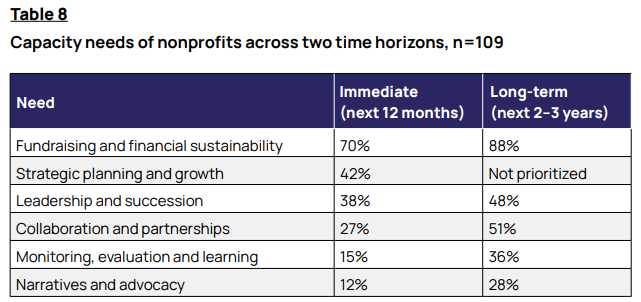
Several things are worth holding together from these results.
- 1.Fundraising moves from a third of immediate responses to near-universal agreement at 90%, signalling that the sector reads its funding challenge as structural and long-term rather than temporary.
- 2.Collaboration and partnerships are registered as a priority for around 27% of organizations in the near term, but rise to 52% over the longer term. This is evidence of constraint.
- 3.MEL, narratives, field coordination — the functions that are most absent from immediate priorities, but become a part of the longer-term signal the need for field-building.
1. Fundraising moves from a third of immediate responses to near-universal agreement at 90%, signalling that the sector reads its funding challenge as structural and long-term rather than temporary.
2. Collaboration and partnerships are registered as a priority for around 27% of organizations in the near term, but rise to 52% over the longer term. This is evidence of constraint.
3. MEL, narratives, field coordination the functions that are most absent from immediate priorities, but become a part of the longer term signal the need for field-building.
The sector is not unaware of what it needs. It is unable to fund those needs in the
present.
Immediate needs are internal and operational: securing funds, retaining staff, and
managing delivery. Long-term needs are systemic: collaboration, coordination,
shared infrastructure. The distance between those two registers, and the gap in
funding that maintains it, is where funders need to act.
As systems of welfare, finance, and identity have expanded, their architecture
has not always expanded with accessibility in mind. In 2025, the Supreme Court
observed that inaccessible digital KYC processes were preventing persons with
disabilities from opening bank accounts and accessing essential services —
effectively excluding them from systems that had already become mandated for
participation.69 Capacity, in this sense, is a function of how systems are designed,
how they expand and contract, and who they are designed to include.
4.2.2 Fundraising and Leadership: Foundational Pressures on Organizational Stability
That fundraising should dominate both time horizons is, on one level, predictable —
and on another, worth examining more closely. A large majority of organizations in
our sample (84%) had been operating for over a decade. This indicates that funding
is not an early-stage fragility. It is a condition that persists over time, settling into
something chronic and less visible.
Smaller organizations operating with budgets under INR 1 crore report immediate
fundraising pressure at significantly higher rates than mid-sized or large ones.
Funding comes, extends, drops, and reappears in ways that rarely allow planning
beyond the immediate horizon. “You are always between grants, never fully inside
one,” shared Dr. Lakshmi Narasimhan from The Banyan Academy of Leadership
in Mental Health. Dr. Dipti Gandhi, Muskan Foundation, described the constant
recalibration this produces: “We plan for a year, but think in quarters, and survive
month to month.”

Mid- and large-sized organizations show the sharpest demand for strategic
planning and growth as an immediate need, suggesting a ceiling that emerges
once organizations move beyond survival but before they reach enduring stability.
The geography of this pressure, as in the case of other dimensions of practice,
is uneven. Urban organizations with proximity to corporate networks, proposal
infrastructure, and relationship capital can navigate funding with greater traction.
For rural and remote organizations, the system is difficult and inaccessible. “The
population we serve is very thinly dispersed and scattered,” Prashant Sude, GSP
India Grameen Shramik Pratishthan described — a condition that also applies to the
funding meant to reach them.
This unevenness has material implications. In Karnataka, recent budget reductions
sharply cut allocations for assistive devices such as Braille kits and talking laptops,
leaving hundreds of visually impaired students waiting without support. What
appears as a capacity gap at the organizational level is often the downstream
effect of such systemic volatility. Similarities persist at the level of individuals
and families. Access to pensions, allowances, and welfare schemes is frequently
mediated through fragmented processes, documentation gaps, and repeated
verification requirements, making continuity of support uncertain even where
entitlements formally exist.
Leadership sits alongside fundraising in this foundational layer. The sector is old
enough that founder dependency is a structural need. Organizations built on
lived experience, personal networks, and institutional knowledge now face the
question of continuity without having been supported to foster it. Almost 35%
of organizations included persons with disabilities in governance roles, but only
20% are disability-led at the founder or CEO level. Organizations closest to lived
experience are often among those operating with the least institutional support.
"We want exact numbers, exact figures, exact activity, exact everything," said
Nidhi Goyal from Rising Flame, “but people don't want to fund those who are
executing, or leading organizations." The ability to invest in second-line leadership,
governance systems, or institutional memory requires resources that are rarely
explicitly prioritized by funders. At 49%, leadership development and succession
planning appeared clearly as long-term capacity needs in our data. However, the
groundwork for them cannot be laid from within program budgets alone.
Recent workplace inclusion efforts continue to note that while organizations
increasingly adopt disability inclusion policies, gaps in accessibility, training,
and institutional readiness limit actual participation.71 Here, as elsewhere, the
constraint is not recognition — it is the systems and resourcing that determine
whether policy becomes practice.
4.2.3 Collaboration and the Missing Middle: Why Collective Work Stays Fragile
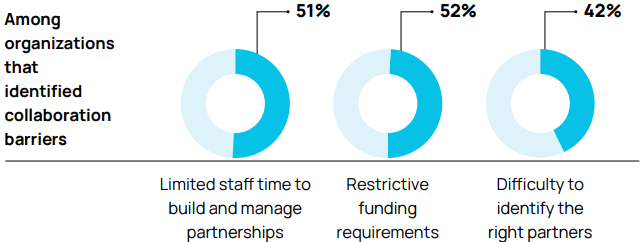
Collaboration and partnerships registered as a priority for around 27% of organizations in the immediate term, but rose sharply to 52% in the long term. Among organizations that identified collaboration barriers, 51% cited limited staff time to build and manage partnerships, 52% pointed to restrictive funding and reporting requirements, and 42% said it was difficult to identify the right partners. This gap is not about willingness. Even where intent exists, the conditions to sustain collaboration do not.
Sitting beneath both the fragmentation and the desire to overcome it is a structural absence that the sector itself names with considerable precision: the missing middle. Not missing in recognition — organizations can describe, often in operational detail, the coordination mechanisms, shared systems, and platforms that would change how the field functions. Missing in the sense of being systematically unfunded, treated as overhead rather than architecture, often valued in conversation but starved in practice.
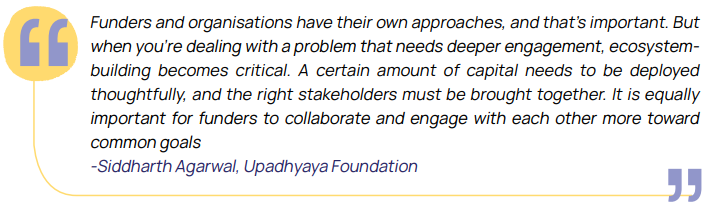
Across the social sector, functions such as coordination, knowledge infrastructure,
and ecosystem-building are widely acknowledged as critical but among the least
directly funded reinforcing a system where collective capacity is expected but
not resourced for. Most notably, collaboration and partnerships do not register as
a dominant priority for organizations in the immediate term (around 27%), often
overshadowed by more urgent demands, and then rise sharply to 52% as a longterm
priority. This indicates that organizations are not unwilling to collaborate; they
are unable to afford or account for it presently. Amid limited staff time, restrictive
funding requirements, and constraints in terms of identifying the right partners,
pathways to collaboration are riddled with bottlenecks.
For organizations working in rural or remote geographies, the pathways to
collaboration are far less available. “Even meeting regularly is difficult,” Bashir
Ahmad Lone, Voluntary Medicare Society shared. Nargis Khatoon from Srijan Mahila
Vikas Manch added,“Travel itself becomes the barrier in hard-to-reach regions
with geographically difficult terrain.” In such contexts, collaboration is not only
about alignment, but access — to people, platforms, and the time required to build
relationships.
Qualitative accounts illustrate the relational texture of collaboration under
constraint.“I would love to see an ecosystem that is more compassionate,”
Myroslava Tataryn, Disability Rights Fund reflected, pointing to an environment
where competition is accepted as a norm. The fragmentation that follows is
adaptive, shaped by conditions where visibility, access, and participation are
unevenly distributed and systematically demarcated, even within spaces designed
for collaboration.73 “If you put ten visual impairment organizations together, they'll
compete for funding, visibility, and influence,” said Shilpi Kapoor, BarrierBreak.
“Fear drives secrecy.” This observation names something that sits uncomfortably
beneath most formal accounts. Over time, organizations in this landscape may
have discovered that the architecture around them rewards isolation more readily
than cooperation.
Also visible in the same landscape is that organizations find ways to work together,
often informally, sometimes deliberately. Qualitative data surfaced several
examples of locally sustained collaboration, including coordination between
nonprofits in Dehradun, hub-and-spoke outreach in Karnataka, peer problemsolving networks in Pune, and forms of public-system collaboration in Tamil Nadu,
though these remained dispersed, locally held, and difficult to sustain without
dedicated support. In each case, collaboration was enabled by some form of
supporting infrastructure, such as a convening, a platform, or even a shared
communication channel. The infrastructure required was often modest, but it
mattered that it existed, and that it was held long enough for trust to accumulate.
These examples illustrate that collaboration is not absent, but instead fragile.
Without sustained support, it remains episodic rather than structural.
4.2.4 Field-Building on Program Budgets: Ecosystem Work Without Ecosystem Funding
There is a category of organization in this landscape that the funding architecture has never quite known how to hold. What these organizations do is among the most legible and consequential work in the sector, but it typically does not produce the kind of outputs that grant cycles are designed to hold. These are the field-builders: organizations that have absorbed convening, peer-strengthening, research, institutional memory, and coalition work into their identity, and that carry out these efforts largely in the margins of grants designed for something else.
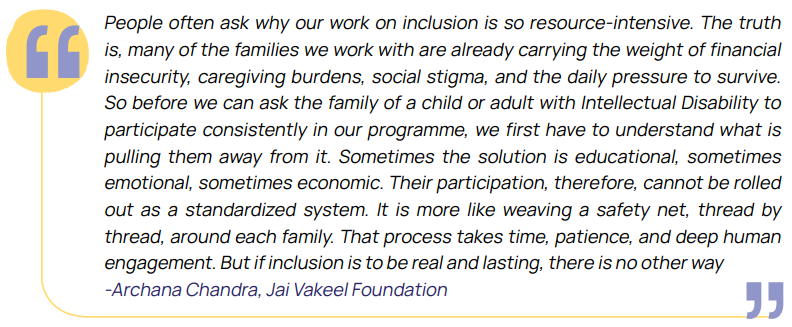
Ecosystem-facing functions such as research, narrative building, convening, are
among the least funded, even when widely recognized as critical. This reflects a
deeper misalignment in how value is defined. Work that produces system-level
change operates on longer time horizons and diffused outcomes, almost by design.
This makes it less legible to funding models oriented towards results that can
be clearly quantified and attributed. The organizational response is predictable.
When field-building work is unfunded, it gets relocated into unrestricted funds,
leadership time, and institutional margins. As a result, a significant portion of the
sector’s core is being built and maintained without formal recognition, and without
sustainable resourcing. Global disability inclusion efforts increasingly recognize
that such connective infrastructure is essential for sustained change, despite its
low visibility in the mainstream.
This is a load-bearing arrangement that is unsustainable. The sector is currently
asking its most experienced organizations to absorb field-building functions as
a condition of participation. That arrangement works until the founders carrying
institutional memory step back, the networks built on personal relationships
dissolve, or the organizations doing ecosystem work conclude that the cost is no
longer manageable. Articulating the critical value delivered to the ecosystem by
field-building initiatives is a necessary first step towards resourcing this work with
greater ambition and vigor.
4.2.5 Limits of the Current Model: What Cannot Sustain
Organizations in this sector have learned to keep moving, filling gaps that systems
leave open, holding continuity that funders do not pay for, and carrying fieldbuilding functions in the margins of grants designed for something else. This
absorption has been misread for too long as resilience — as though the capacity to
continue under constraint is evidence that the constraint is manageable.
More precisely, while the disability inclusion ecosystem looks like it is holding
together, it can also be understood as a sector that is compensating. This
compensation is disproportionate: it falls heaviest on organizations closest to the
ground, least resourced to carry it, and most distant from the funding relationships
that might eventually relieve it. Founder-led organizations without second lines.
Rural organizations without the runway to build systems. Field-builders doing
ecosystem work on program budgets, invisible to the logframes that determine
what counts.
Four structural conditions cannot be sustained under the current approach:
-
 Capacity treated as overhead rather than foundation – organizations are expected to build institutional systems without explicit funding for them.
 -
Coordination expected but never resourced – collaboration is identified as critical by over half the sector’s long-term respondents but is practically absent from funded work.
-
Leadership continuity left to chance – succession planning and second-line development require dedicated investment that uniform grant models do not provide.
-
Differentiated need met with uniform models – the pressures facing a rural, founder-led organization under INR 1 crore are categorically different from those facing a mid-sized urban one; the funding architecture does not yet reflect this.

Bridgespan's field-building framework offers funders a precise vocabulary for what
this sector is already attempting and what it needs resourced.
Our research emphasizes that the core needs of nonprofit organizations are met
most effectively when momentum is directed toward field building. This is achieved
through collaborative action designed to consolidate outcomes and strategically
influence funders.
Leadership development, so organizations can sustain themselves beyond their
founders. Network-building and coordination, so collaboration becomes structural
rather than episodic. Research and knowledge generation, the sector can speak
from evidence. Narrative change, so nonprofits can act from a position of shared
purpose rather than fragmented survival.
These efforts are preconditions for the ecosystem’s work being credible,
sustainable, and heard. The sector has named them consistently and in detail,
across both survey data and qualitative testimony. The gap lies in whether funders
are willing to resource the field-building capacity that determines whether
organizations can sustain their leadership, advocate for their work, and shape the
systems they are trying to change. Capacity, understood this way, is not a support
function. It is the condition through which everything else becomes possible.
The ecosystem is experienced through sites like block offices, hospital assessments, and classrooms by people with disabilities in India. Behind every policy mandate and delivery gap is a set of actors whose decisions and span of influence determine what inclusion can look like. The table below maps the actors in this ecosystem, sketching out a picture of where leverage and influence sit, how they move, and what helps them reach the communities they serve.
The preceding chapters show that disability inclusion is constrained by fragmentation across systems, funding, and accountability. Nonprofits are often required to bridge these gaps informally, sustaining continuity where formal systems do not. Breakpoints reveal where exclusion is reproduced; funding flows reveal why responses remain uneven. The cornerstones that follow do not propose new actors; they clarify the conditions required for collective action across those already present: government, philanthropy, industry, civil society, and disabled people themselves. The task is not to add complexity, but to build alignment around what makes inclusion durable.