Chapter 05: Cornerstones for Collaborative Action: Strategic shifts for government, philanthropy, industry, and civil society
This chapter articulates shifts required to deepen the ecosystem of disability inclusion, if held in common by actors across the field, including philanthropy, industry, government, and practitioners from various domains. Each cornerstone is a principle that cuts across stakeholders, domains, and levels, distilling evidence into specific and actionable responses for those best positioned to leverage them.
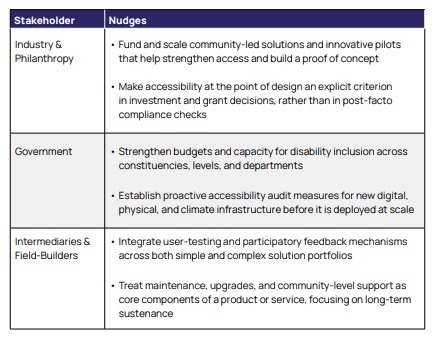
5.1 Cornerstone 1: Designing Access as a First Principle
Access is most powerful when it is assumed from the start. When systems,
products, and services are designed around a non-disabled norm, access becomes
an accommodation made for something or someone that is an ‘outlier’. On the
other hand, when access is a founding condition, it shapes what gets built, who
is consulted, and how success is evaluated. Universal design must be understood
as an institutional disposition and ethic around which resources, capabilities, and
representation must be oriented.
The pace at which new infrastructure is being built in India calls for this principle
to be integrated with urgency. Digital public goods, financial systems, and built
environments all emerge as domains that can become new access points or create
new barriers, depending on how they are designed. Access as a first principle
provides a window of opportunity to embed universality and inclusion before
standards around new services and environments calcify. When inaccessibility
is embedded instead, it can also become expensive and cumbersome to undo,
excluding users by default until it is corrected – illustrating how human costs
cascade. Testing and designing with the most excluded users first, building
feedback loops into implementation, and accounting for maintenance and upgrades
all help unpack and respond to inaccessibility that begins as a design problem.
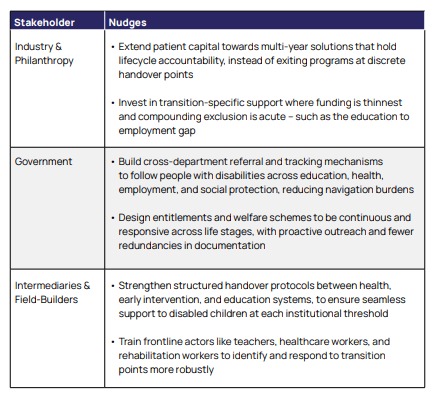
5.2 Cornerstone 2: Resourcing Lifecycle Continuity
Disability inclusion is a condition that must be maintained across the full arc
of a person’s life. Early identification, school participation, the education to
employment transition, and access to social protection in adulthood: each stage
shapes the next, and anything that is missed at one point typically compounds
forward. The organizations in this ecosystem understand this intuitively. Many of
them describe following the person as a core feature of their work. This is what
helps services and programs stay present across transitions that formal systems
are yet to acknowledge and bridge, holding continuity that single program budgets
cannot account for.
Making accountability to the lifecycle a shared principle entails applying this
orientation at the level of systems, not just on-ground practice. Infrastructure
across education, employment, health, and other domains must speak to one
another across stages. Siloed action on these fronts leads to entire stages in the
diverse lifecycles of disabled people where support and protections are simply
missing altogether. The cost of navigation and follow-through in these stages is
often absorbed by caregivers and frontline actors. Accounting for this continuity
is one of the sector’s most tangible and least visible contributions. When no single
actor is formally understood to be accountable for what happens in the move
from one system or program to the next, handovers, follow-through, and longterm support become challenging to extend. Treating the lifecycle as a unit of
accountability can help address these white spaces and deepen impact.
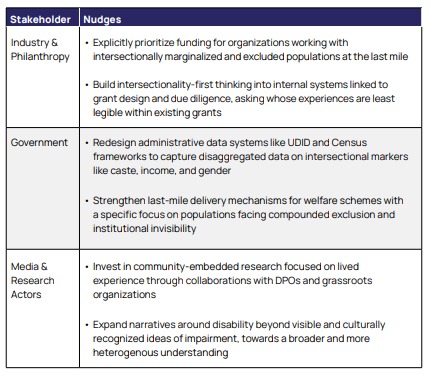
5.3 Cornerstone 3: Addressing Compounded Exclusion at Its Roots
Disability is shaped by the social and economic contexts in which it is situated. In
India, these contexts are defined by caste, class, gender, religion, geography, age,
and other markers in ways that compound, as opposed to being merely additive.
A Dalit woman with a psychosocial disability in a remote district faces a specific
configuration of exclusion that is qualitatively different from what any single
marker can help predict. The field knows this. Practitioners describe such contexts
with care, asking who gets counted in government data, who can physically reach a
certification center, who is believed when they report violence, who is considered a
viable candidate for employment. The pattern is consistent: the further a disabled
person sits from the norm around which systems were built, the less legible they
become to those systems
Demarcating intersectionality as an analytical starting point changes how the
field looks at inclusion and what it designs in response. Asking whose experience
is not yet legible – within data, narratives, institutions, and entire systems – calls
for identifying who sits at the last mile when it comes to specific and situated
forms of access. Organizations that work at these intersections often have strong
community linkages and hyperlocal impact, despite being small in scale and
embedded in remote geographies. The populations they serve are typically the
most difficult to make legible within funding architectures that reward scale and
visibility. Shifting this requires deliberate choices across every stakeholder, built
along intersectionality-first thinking.
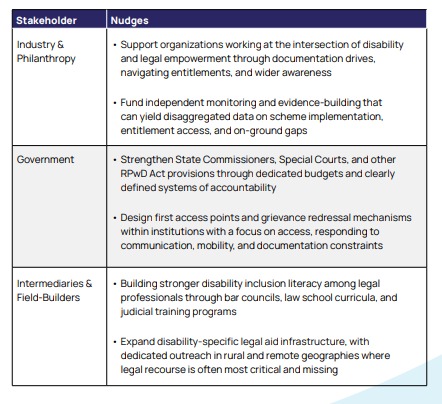
5.4 Cornerstone 4: Building Accountability Infrastructure
In India, the RPwD Act, international commitments, and a sequence of judicial
interventions have expanded the formal framework of rights for people with
disabilities substantially over the last decade. Yet, the field increasingly recognizes
gaps in implementation, ranging from provisions that lack implementation infrastructure to entitlement processes that require navigating complex
bureaucratic machinery and lack redressal mechanisms. Policy inclusion is often
necessary, but not sufficient, for change in institutional behavior. Across domains,
the cost of claiming a right is routinely borne by those that it was designed to
protect. The lag in appointing State Commissioners and Special Courts mandated
under the RPwD Act provides a visible manifestation of the problem – the grievance
infrastructure envisioned by the law has not materialized at scale.
Closing this gap requires making the architecture of accountability proactive
rather than reactive. This is as much a sociopolitical and institutional question
as a technical one. It requires actors in the ecosystem to embrace accountability
towards processes, timelines, and the people cross-located furthest from systems.
Where this has worked, it has entailed sensitization and awareness by disabilityled organizations and movements, independent monitoring, and resourcing that
treats legal aid and advocacy with the same relevance as other service delivery.
At a deeper level, bridging the gap between legal frameworks and on-ground
implementation calls for strengthening capacities and commitments towards
destigmatizing disability, particularly within government and legal institutions
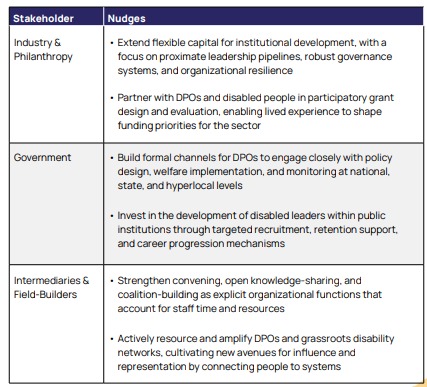
5.5 Cornerstone 5: Investing in Disabled Leadership and Connective Infrastructure
The principle of “nothing about us without us” is widely cited across the disability
inclusion ecosystem. In practice, however, people with disabilities are more often
the recipients of programs than the architects shaping them. Disabled people’s
leadership is an epistemological gesture. The knowledge that comes from the lived
experience of disability, particularly when they’re situated at the intersections of
markers like caste, gender, and geography, is not replicable through good intent
or removed technical expertise. When these perspectives are underrepresented
in corridors of influence, the field continues to obscure what is happening on the
ground no matter how sophisticated frameworks become.
Alongside leadership, the ecosystem has historically relied on connective
infrastructure that is rarely prominently visible and supported. Convenings, peer
networks, coalition work, and knowledge-sharing platforms are key to enabling a
sector to operate as a field. DPOs occupy a particular place in this infrastructure.
Typically emerging from within the folds of movements, they are among the
field’s most credible and proximate accountability mechanisms, remaining underresourced. When this connective infrastructure is sustained, it allows the field
to learn together, build shared agendas across organizations and mandates, and
generate a wider body of evidence that can inform policy engagement. It also
creates the conditions required for disabled leadership to develop and persist as
an institutional norm that can be replicated across the ecosystem, emboldening
voices from the ground.