Chapter 03
Where Inclusion Breaks: Breakpoints and intervention patterns across the disability ecosystem
Chapter 06: Time Horizons for Disability Inclusion – From Immediate Access to Long-Term Systems Change
Change in disability inclusion does not happen at a
uniform speed, necessarily. Some priorities require
immediate strengthening within existing systems, while
others depend on longer-term institutional and narrative
shifts. The three horizons framework helps locate these
efforts across time: from access to formal recognition
and services, to institutional pathways for inclusion, to
systems integration and field leadership. Read this way,
the horizon model is a map of overlapping responsibilities
that must deepen together.
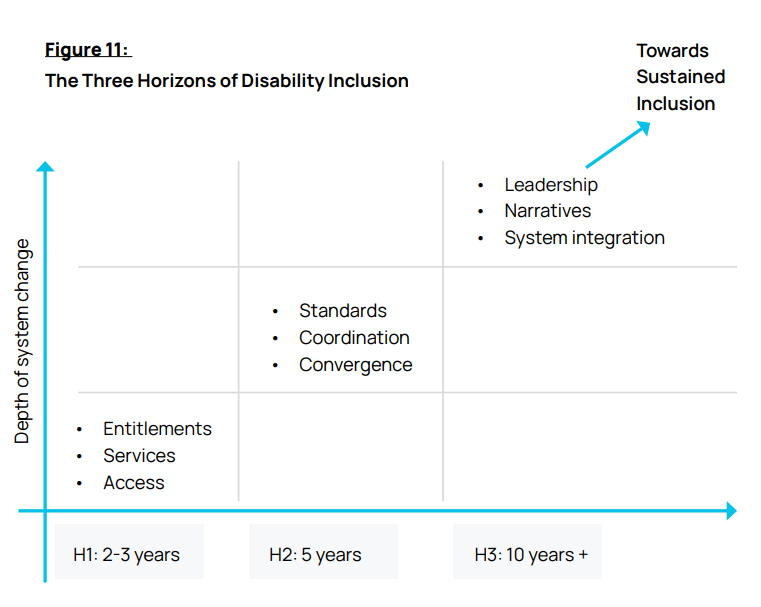
The Three Horizons framework offers a lens to understand this evolution as a set
of overlapping and mutually reinforcing shifts in focus and ambition. Rather than
moving on from earlier roles, ecosystem actors are required to operate across
horizons simultaneously: strengthening existing systems, embedding inclusion
within institutions, and enabling long-term alignment and leadership across the
field. The cornerstones identified in this report act as pathways through these
horizons, deepening inclusion for the future, while remaining grounded in present
realities.
-
 Horizon 1: Strengthening Access to Existing Systems and Services The foundation of the ecosystem lies in formal recognition and access—legal entitlements, disability certification, service delivery, assistive technology, and rehabilitation support. These are not transitional activities; they remain essential for millions of people still outside the reach of even basic provisions. Horizon 1 focuses on strengthening reach, quality, and continuity—ensuring that existing systems work more effectively, even as the ecosystem builds toward deeper change.
 -
Horizon 2: Embedding Institutional Pathways for Inclusion The next frontier is institutional. This requires moving beyond individual service delivery to embedding inclusion within how systems operate. It includes developing standards and protocols, advancing accessibility norms, enabling cross-sector coordination, and strengthening government partnerships. Horizon 2 focuses on building consistency and scale—shifting inclusion from isolated programs to practices embedded within institutions.
-
Horizon 3: Enabling Systems Integration and Field Leadership The long horizon requires two reinforcing shifts: strengthening field leadership and enabling systems integration. This includes shaping narratives and leadership-building disability-led networks, advancing representation, and influencing discourse—while embedding inclusion across systems through integrated policy, financing, data, and accountability mechanisms. Horizon 3 focuses on sustaining inclusion through alignment—where systems, leadership, and institutions move together toward long-term coherence. Taken together, the Three Horizons underscore a central insight of this report: the future of disability inclusion in India will be built not through the tension between immediate delivery and long-term transformation. Progress will be driven by actors and investments capable of working across horizons, responding to urgent needs while simultaneously building the institutional, systemic, and leadership foundations required for durable inclusion.

Supporting this mandate is not only a strategic imperative for the sector, but a necessary condition for achieving equitable and inclusive development at scale.
Please note: The Three Horizons Framework is a foresight model used to manage transformational change. Horizon 1 represents the current system and its declining relevance; Horizon 2 involves the “pockets of the future” or innovations that disrupt the status quo; and Horizon 3 envisions the long-term systemic shifts required for a sustainable future. Organizations use this to balance immediate needs with longterm field-building goals.
Annexures
Methodology Note
This report draws on a mixed-methods research design combining secondary
research, primary qualitative inquiry, and a nonprofit diagnostic survey.
The secondary research included a review of laws, policies, schemes, judicial
developments, published literature, and available sectoral data relevant to
disability inclusion in India. This helped situate the study within the current policy
and institutional landscape and informed the analytical lenses used in the report.
The primary research consisted of 23 semi-structured interviews with
stakeholders from the disability ecosystem, including nonprofit leaders, disability
rights practitioners, philanthropic actors, researchers, and other sector enablers.
In addition, two FGDs were conducted with 9 nonprofit practitioners to deepen
understanding of shared organizational realities, including collaboration, capacity
constraints, and ecosystem gaps.
To complement the qualitative inquiry, Dasra administered the Disability NGOs
Capacity & Ecosystem Diagnostic Survey, which was circulated online through
Dasra’s networks as well as partner and ecosystem networks. It was designed
as a structured diagnostic tool to gather information on organizational scale,
budgets, geographic reach, leadership composition, disability focus, areas of work,
collaboration patterns, operational bottlenecks, and short- and long-term capacity
needs. Following final data cleaning, three duplicate survey responses were
removed. The final analytical sample comprises 109 organizations.
The study used purposive and convenience sampling across its primary research
components. As a result, the findings are indicative rather than statistically
representative of the disability ecosystem in India. Organizations and actors that
are smaller, less networked, more informally organized, less digitally connected, or
based in remote or conflict geographies may be underrepresented
Limitations: While this research surfaces critical patterns, tensions, and operating realities across the ecosystem, several limitations must be acknowledged. First, the study may underrepresent smaller, informal, or less networked actors who often operate outside established visibility. Furthermore, the analysis maintains an implicit focus on civil society; consequently, the specific roles of the family, community, the state, and the market in ensuring disability inclusion have been explored only in a limited manner. Finally, the findings and interpretations may be influenced by our inherent bias and positioning as a sector intermediary within the philanthropic landscape.
Acknowledgements
This report was developed as part of HSBC India’s partnership with Dasra to
strengthen the disability ecosystem in India through a landscape study, stakeholder
consultations, a nonprofit diagnostic survey, and the design of a longer-term
ecosystem-strengthening initiative. It builds on a shared commitment to examining
disability inclusion not as a narrow sectoral concern, but as a structural question
that cuts across institutions, lifecycles, and systems.
We are grateful to HSBC India for their support, partnership, and belief in the
importance of investing in evidence, institutional strengthening, and long-horizon
thinking for disability inclusion. We are especially thankful to Aloka Majumdar for
her stewardship of this work and for helping anchor the report within a broader
commitment to strategic, sustained action on disability inclusion. The research
and report were led by the Research and Insights team at Dasra, in collaboration
with Cohorts & Training, and Catalytic Philanthropy teams, with contributions
spanning research design, stakeholder engagement, analysis, synthesis, and
strategic direction. The broader project team and leadership team guiding this
work included Neera Nundy, Deval Sanghavi, Ami Misra, Pratyaksha Jha, Yash
Thakoor, Rukmini Banerjee, Arshiya Uraizee, Unaiza Rajan, Kavneet Kaur, Jija Dutt,
Harshita Maheshwari, Shrestha Satpathy, Divya Puri, Jessica Bernard, Gaurvi
Singhvi, and Ayush Mehrotra. We extend our sincere appreciation to the nonprofit
leaders, disability rights practitioners, funders, researchers, intermediaries, and
other ecosystem actors who shared their time, experiences, and reflections with
us through interviews, focus group discussions, and consultations. Their insights
made it possible to understand the disability ecosystem through the operational
realities, tensions, and forms of care, translation, and continuity that hold it
together in practice. The report also draws on the responses of 109 organizations
that participated in the online survey, whose contributions helped anchor the
analysis in patterns visible across the broader nonprofit landscape. We would like to
extend our sincere gratitude to Atypical Advantage for serving as the accessibility
consultant for this report and for their valuable guidance in helping make this
publication more inclusive and accessible.
Above all, we acknowledge persons with disabilities, caregivers, and community
actors whose lives, labor, and daily negotiations with exclusion sit beneath every
institutional question this report asks. Even where they are not always directly
visible in the research process, their realities shape the field, and their experiences
remain central to any meaningful account of disability inclusion in India. We are
conscious that this report draws on knowledge produced through lived experience,
movement-building, practice, and long years of work across the ecosystem. We
hope it contributes, in however partial a way, to efforts aimed at building a more
accountable, inclusive, and dignified social order.
List of Sector Experts and Practitioners (A-Z)
- Anjanaben Acharya, Ashirvad Viklang Trust Sayla
- Archana Chandra, Jai Vakeel Foundation
- Bashir Ahmad Lone, Voluntary Medicare Society (VMS)
- Beverly Luis, Mann
- Bhavana Mukherjee, ADAPT (formerly Spastics Society of India)
- Bhumika Modh, Association of People with Disabilities (APD)
- Birbal Prasad, Manav Vikas Jharkhand
- DPK Babu, Akshay Akruti
- Disket Angmo, Mann Talks
- Dr. Aman Preet Kaur, Bajaj Finserv
- Dr. Anita Limaye, Ummeed Child Development Center
- Dr. Dipti Gandhi, Muskan Foundation
- Dr. Koyeli Sengupta, Ummeed Child Development Center
- Dr. Lakshmi Narasimhan, Banyan Academy of Leadership in Mental Health
- Dr. N.S. Senthil Kumar, Association of People with Disabilities (APD)
- Dr. Nandini Ghosh, Institute of Development Studies (IDS), Kolkata
- Dr. O P Kulhari, CULP - Centre for Unfolding Learning Potentials
- Dr. Pratima Sasindran, Gramin Shramik Pratishthan (GSP)
- Gazala Paul, Paul Hamlyn Foundation & Samerth Charitable Trust
- Jo Chopra-McGowan, Latika Foundation
- Karthikeyan Ganesan, Sristi Foundation
- Adv. Mrunmayee Rajabhau Jodh, Manav Vikas Foundation (MVF), Nagpur
- Myroslava Tataryn, Disability Rights Fund (DRF)
- Nargis Khatoon, Srijan Mahila Vikas Manch
- Neha Soneji, Tech Mahindra Foundation
- Nidhi Goyal, Rising Flame
- Nipun Malhotra, Nipman Foundation & The Quantum Hub
- Paul Ramanathan, SAMA Foundation
- Payal Wadhwa, Jai Vakeel Foundation
- Prashant Sude, GSP India Grameen Shramik Pratishthan
- Prateek Madhav, AssisTech Foundation (ATF)
- R.A. Gopal, Global Trust
- Radhika Kannan, Miraiwala Health Initiative (MHI)
- Richa Bhutani, Tata Institute of Social Sciences
- Shamin Mehrotra, Ummeed Child Development Center
- Shilpi Kapoor, BarrierBreak
- Siddharth Agarwal, Upadhyaya Foundation
- Sonali Saini, Sol's ARC
- Srilakshmi Bellamkonda, Dr. Reddy's Foundation
- Sudeep Goyal, Asha Ka Jharna
- Sushri Sangita Deo, Sadbhabana
- Subhojit Goswami, The Leprosy Mission Trust India
- Usha V, Akshay Akruti
List of Survey Respondents (A-Z)
- A Hand for Help Development Society
- Aaina
- Acc-Red
- ACT2Enable Aadhaar Counselling and Therapy Council
- Action for Autism
- Amar Seva Sangam
- Amhi Amchya Arogyasathi
- Anushkaa Foundation for Eliminating Clubfoot
- Arj Foundation
- ARVI TRUST
- Autism Welfare Trust
- AWMH Maharashtra
- Bijapur Integrated Rural Development Society (BIRDS)
- Blink Foundation
- Buzz Women
- Calcutta Blind School
- Centre for Community Initiative
- Centre for Mental Health Law and Policy, Indian Law Society
- Chehak Trust
- CORD
- Craftizen Foundation
- CULP - Centre for Unfolding Learning Potentials
- Dantan Manav Kalyan Kendra
- Darbar Sahitya Sansada
- Diocese of Varanasi Social Welfare Society
- Dr. Anjali Morris Education & Health Foundation
- Ekalavya Educational And Charitable Trust
- EKTA
- Evoluer Solutions
- Future Hope
- Ganpati Educational Society
- Geohazards Society
- Global Trust for the Differently Abled
- Gramin Vikas Sansthan
- Hind Yuva Shakti
- Jai Vakeel Foundation & Research Centre
- Jan Vikas Samiti
- Jeevandeep Health Education and Charitable Trust
- JYOTIRMAY NGO (Under the aegis of Lila K. Jagtiani Foundation)
- Kalp Samaj Sevi Sanstha
- Kandhamal Zilla Sabuja Vaidya Sangathan
- Karnataka Hemophilia Society Davangere
- Kaveri Counselling Empowerment & Gifted Centre
- Kenduadihi Bikash Society
- Krida Vikas Sanstha (Slumsoccer)
- Lohardaga Gram Swarajya Sansthjan
- Lok Kalyan Seva Kendra
- Manav Vikas Foundation
- Mitra Jyothi
- Movement for Alternatives and Youth Awareness
- Muskaan-PAEPID
- Muskan Foundation
- National Association of the Deaf
- Naykshitij
- NEAID
- Odisha Rising Foundation
- Prabhat Education Foundation
- Pranjal Welfare Foundation
- Pratham Education Foundation
- Prerak
- Prodigals' Home
- Rainbow Special Education and Rehabilitation Foundation
- RampMyCity
- Raphael Ryder Cheshire International Centre
- Rising Star Khilte Chehre
- SaaD
- Sadbhabana
- Saheli HIV AIDS Karyakarta Sangh
- SAMA Foundation
- Samarthanam Trust for the Disabled
- Samerth Talim Kendra Operated by Samerth Charitable Trust
- Samhita
- Sanchar AROD
- Sangath
- Sankalp Sanskritik Samiti
- Santhivardhana Ministries
- SARDS
- Satya Special School
- Service Initiative for Voluntary Action Trust
- SEWA Punjab
- Shanta Memorial Rehabilitation Centre
- Shikshit Yuva Sewa Simiti
- Sisu Vikas Samiti
- Snehadhara Foundation
- Sri Nrusingha Dev Anchalika Yuba Parisada (SNDAYP)
- Srijan Mahila Vikash Manch
- Sristi Foundation
- Tamana
- Team Vision Foundation
- The Association of People with Disability
- The Banyan
- The Education Audiology and Research Society
- The Leprosy Mission Trust India
- The Stephen High School for the Deaf
- The Victoria Memorial School for the Blind
- Torchit
- Udayan Care
- Udbhav Vision Foundation
- Ummeed Child Development Center
- Umoya Sports
- UNNATI - Organisation for Development Education
- V Can Autism Foundation
- Vidhi Centre for Legal Policy
- Vidyaranya
- Vipla Foundation (Save The Children India)
- Vivekanand Lok Vikas Sansthan
- Voluntary Integration for Education and Welfare of Society (VIEWS)
- Voluntary Medicare Society (VMS)
- Youth4Jobs Foundation
References
- World Health Organization, ‘Disability and Health’, WHO, 2023; Ministry of Statistics and Programme Implementation, ‘Disabled Persons in India: A Statistical Profile 2016’, Government of India, 2016; Press Information Bureau, ‘Persons with Disabilities in India: NSS 76th Round’, Government of India, 2019.
- Government of India, ‘The Rights of Persons with Disabilities Act, 2016’, 2016; Supreme Court Observer, ‘Visually Impaired Candidates Cannot Be Excluded from Judicial Services’, 2025; Vidhi Centre for Legal Policy, ‘Digital Access as a Fundamental Right’, 2025.
- Sebastian Buckup, ‘The Price of Exclusion: The Economic Consequences of Excluding People with Disabilities from the World of Work’, International Labour Organization, 2010.
- Rashmi R, Mohanty SK. Socioeconomic and geographic variations of disabilities in India: evidence from the National Family Health Survey, 2019-21. Int J Health Geogr. 2024 Feb 18;23(1):4.
- Mitra S, Posarac A, Vick B. Disability and poverty in developing countries: a multidimensional study. World Dev. 2013;41:1–18.
- https://www.developmentpathways.co.uk/wp-content/uploads/2021/02/India-disabilityFeb-2021-1.pdf
- https://www.niti.gov.in/sites/default/files/2024-02/NITI%20WORKING%20PAPER_Report.pdf
- Mehrotra, N. (2011). Disability Rights Movements in India: Politics and Practice. Economic and Political Weekly, 46(6), 65–72.
- https://niua.in/intranet/sites/default/files/2458.pdf
- Mehrotra, N. (2011). Disability rights movements in India: Politics and practice. Economic and Political Weekly, 65-72.
- https://static.pib.gov.in/WriteReadData/specificdocs/documents/2024/oct/doc2024105410301.pdf
- Mehrotra, N. (2011). Disability rights movements in India: Politics and practice. Economic and Political Weekly, 65-72.
- United Nations, ‘Convention on the Rights of Persons with Disabilities (CRPD)’, United Nations Department of Economic and Social Affairs, 2006.
- Department of Empowerment of Persons with Disabilities, Accessible India Campaign, Government of India.
- Department of School Education and Literacy, Ministry of Education, Government of India, UDISE+ 2024–25: Key Results — All India.
- World Bank, People with Disabilities in India: From Commitments to Outcomes.
- World Bank, ‘People with Disabilities in India: From Commitments to Outcomes’, World Bank, 2009.
- International Labour Organization (2019), The Next Normal: The changing world of work; World Bank (2022), Disability Inclusion in India: A Path to Inclusive Growth.
- NITI Aayog and SAMRIDH Healthcare Blended Finance Facility. Reimagining Healthcare in India through Blended Finance. New Delhi: NITI Aayog, 2022.
- Ministry of Social Justice and Empowerment (various years), Annual Reports; World Bank (2022), Social Protection for Persons with Disabilities in India.
- UNESCO, “N for Nose: State of the Education Report for India 2019, Children with Disabilities,” UNESCO Office in New Delhi, 2019.
- Ministry of Education, Government of India, “Unified District Information System for Education + (UDISE+) 2024-25,” Department of Education & Literacy, 28 August 2025.
- UNICEF, “Global Disability Inclusion Report: Accelerating Disability Inclusion in a Changing and Diverse World,” 2025.
- Ministry of Statistics & Program Implementation, Government of India, “Persons with Disabilities in India (NSS Report No. 583),” National Statistical Office, 2019.
- PTI, “Persons with disabilities represent less than 1% of the corporate workforce: Report,” The Economic Times, 4 December 2025.
- Suraj Singh Senjam & Amarjeet Singh, “Addressing the Health Needs of People with Disabilities in India,” Indian Journal of Public Health 64(1), January-March 2020.
- Disability Rights India Foundation (DRIF), National Centre for Promotion of Employment for Disabled People (NCPEDP), & National Committee on the Rights of Persons with Disabilities (NCRPD), “Two Years of The Rights of Persons with Disabilities (RPWD) Act 2016 – Status of Implementation in the States and UTs of India,” 3 December 2018.
- Nikita Francis, “Less than 40% of disabled persons in India have the ID needed for benefits,” The Hindu, 7 September 2025.
- Young Leaders for Active Citizenship (YLAC), Nipman Foundation, & Samarth by Hyundai with NDTV, “The State of Disability in India,” 2024.
- Ministry of Education, Government of India, “Unified District Information System for Education + (UDISE+) 2024-25,” Department of Education & Literacy, 28 August 2025.
- Ministry of Statistics and Programme Implementation, Government of India, “Persons with Disabilities (Divyangjan) in India – A Statistical Profile: 2021,” National Statistical Office, 2021.
- Shruti Taneja-Johannson, Nidhi Singal, & Meera Samson, “Education of Children with Disabilities in Rural Indian Government Schools: A Long Road to Inclusion,” International Journal of Disability, Development and Education 70(5), 24 May 2021.
- Ajay Mahal et al, “The Earnings and Conversion Gaps for Persons with Disability: Evidence from India,” National Council of Applied Economic Research (NCAER) Working Paper 175, September 2024.
- Ministry of Statistics and Programme Implementation, Government of India, “Persons with Disabilities (Divyangjan) in India – A Statistical Profile: 2021,” National Statistical Office, 2021.
- World Health Organization (WHO), “Global report on health equity for persons with disabilities,” 2022.
- Suraj Singh Senjam & Amarjeet Singh, “Addressing the Health Needs of People with Disabilities in India,” Indian Journal of Public Health 64(1), January-March 2020.
- NCPEDP & Mphasis Foundation, “Inclusive Health Coverage: White Paper on Disability, Discrimination and Health Insurance in India,” 2025.
- Pavithra Jayasankar et al, “Epidemiology of common mental disorders: Results from ‘National Mental Health Survey’ of India, 2016,” Indian Journal of Psychiatry 64(1), January-February 2022.
- Bhavya Johari, “India’s Rights of Persons with Disabilities Act 2016: An Unfulfilled Promise,” 24 June 2024.
- Shivani Gupta, Luc P de Witte, & Agnes Meershoek, “Dimensions of invisibility: insights into the daily realities of persons with disabilities living in rural communities in India,” Disability & Society 36(8), 9 July 2020.
- Rajvir & Dr Deepak Pancholi, “Enhancing Electoral Participation for Persons with Disabilities: Insights from Rajasthan’s State-Level Consultation,” International Journal of Research and Review 12(8), 8 August 2025.
- The Centre for Internet & Society, “Accessibility of Government Websites in India,” 2021.
- Vivien Doll, Sumit Vij, & Jeroen Warner, “How inclusive is disaster risk reduction? Perceptions and predicaments of persons with disabilities during disaster in Assam, India,” Disasters 49(4), 5 July 2025.
- Taslim Uddin et al, “Health impacts of climate-change related natural disasters on persons with disabilities in developing countries: A literature review,” The Journal of Climate Change and Health 19, September-October 2024.
- Andrea M Wojnar, “United efforts required to end violence against people with disabilities,” Hindustan Times, 18 December 2024.
- Gobinda C Pal, “Dalits with Disabilities: The Neglected Dimension of Social Exclusion,” Indian Institute of Dalit Studies Working Paper Series IV(3), 2010.
- Nandita Saikia et al, “Disability Divides in India: Evidence from the 2011 Census,” PLoS One 11(8), 4 August 2016.
- Anjali Vyas, “Removing barriers for persons with invisible disabilities,” India Development Review, 27 June 2025.
- Abhilash Balakrishnan et al, “The Rights of Persons with Disabilities Act 2016: Mental Health Implications,” Indian Journal of Psychological Medicine 41(2), Mar-Apr 2019.
- Amnesty International, “Clouds of injustice: Bhopal disaster 20 years on,” 2004.
- Anita Ghai, Rethinking Disability in India, Routledge, 2015.
- Devi Vijay et al, “Disability inclusion in Indian workplaces: Mapping the research landscape and exploring new terrains,” IIMB Management Review 36(1), March 2024.
- James Staples, “Doing disability through charity and philanthropy in contemporary South India,” Contributions to Indian Sociology 52(2), 23 April 2018.
- Shivani Gupta, Luc P de Witte, & Agnes Meershoek, “Dimensions of invisibility: insights into the daily realities of persons with disabilities living in rural communities in India,” Disability & Society 36(8), 9 July 2020.
- World Health Organization & UNICEF, Global Report on Assistive Technology, 2022, available at: https://www.who.int/publications/i/item/9789240049451
- World Bank, Making Services Work for Poor People, World Development Report, 2004, available at: https://openknowledge.worldbank.org/handle/10986/5986
- The News Minute, ‘Accessible’ government websites still fail disabled users, 2023, available at: https://www.thenewsminute.com/article/accessible-government-websites-still-fail-disabledusers-181903
- Donella Meadows, Leverage Points: Places to Intervene in a System, Sustainability Institute, 1999, available at: https://donellameadows.org/archives/leverage-points-places-to-intervene-in-a-system/
- Stanford Social Innovation Review, The Nonprofit Starvation Cycle, 2009, available at: https://ssir.org/articles/entry/the_nonprofit_starvation_cycle
- Economic Times, India’s nonprofits turn to ‘everyday giving’ amid funding crunch: report, 2025, available at: https://m.economictimes.com/news/company/corporate-trends/indias-nonprofits-turn-to-everyday-giving-amid-funding-crunch-report/articleshow/124331972.cms; see also Business Standard, Indian nonprofits turn to ‘everyday giving’ amid funding crunch: report, 2025.
- Bain & Company and Dasra, ‘India Philanthropy Report 2026’, Bain & Company / Dasra, 2026.
- Nidhi Goyal and Raj Mariwala, ‘Towards Inclusive and Intersectional Philanthropy: Centering Disability in India’, The Wire, 2025.
- Bain & Company and Dasra, ‘India Philanthropy Report 2024’, Bain & Company / Dasra, 2024.
- Bajaj Finserv, ‘Our Commitment to Society: Corporate Social Responsibility’, Bajaj Finserv Annual Report 2024–25, 2025.
- Tech Mahindra Foundation, ‘Disability Inclusion’, Tech Mahindra Foundation, n.d.
- Bain & Company and Dasra, ‘India Philanthropy Report 2025’, Bain & Company / Dasra, 2025.
- Bain & Company and Dasra, ‘India Philanthropy Report 2026’, Bain & Company / Dasra, 2026.
- Priyanka, R., ‘India’s budget for people with disabilities is generous, but remains underutilised’, Scroll.in, 2024.
- Supreme Court of India, ‘In Re: Accessibility of Digital KYC for Persons with Disabilities’, Supreme Court of India, 2025.
- ThePrint, ‘Karnataka struck a blow to disability aid — students waiting for Braille kits, talking laptops’, ThePrint, 2025.
- UNDP India, ‘Bridging the Gap: Enabling Disability Inclusion in India’s Private Sector Workplaces’, UNDP India, 2025.
- Bridgespan Group, ‘Funding Performance, Not Just Programs: A New Mindset for Nonprofit Funding’, Bridgespan Group, 2020.
- India Development Review, ‘The Polite Exclusions of Social Sector Conferences’, India Development Review, 2026.
- UNICEF and Global Disability Summit Secretariat, ‘Global Disability Inclusion Report 2025’, UNICEF / Global Disability Summit, 2025.
- Bridgespan, “Field Building for Population-Level Change,” The Bridgespan Group, March 2020, https://www.bridgespan.org/getmedia/6d7adede-31e8-4a7b-ab87-3a4851a8abac/field-building-forpopulation-level-change-march-2020.pdf.