Chapter 02: The Nonprofit Landscape: Roles, Reach, and Operating Realities
The nonprofit sector in disability
inclusion occupies a position
that is structurally unusual and
rarely named as such. It sits at
the intersection of the state,
the market, the family, and the
community, translating between
systems that do not always speak
to each other, compensating for
functions that have been formally
claimed but practically abandoned,
and holding together the continuity
that no single system has been
designed to provide. While inclusion
is shaped by multiple actors, this
chapter focuses on nonprofits as a
central site of action. It traces how
organizations have accumulated a
form of knowledge about disability
exclusion that exceeds what any
formal system has been willing
to recognize, over decades of
sustained presence.
The chapter draws on survey data and qualitative accounts from across the
nonprofit landscape. The survey reveals a sector that is older and more experienced
than it is typically understood to be, working across a wider range of functions
and geographies than any single program logic would predict. The qualitative
material sits alongside this and surfaces what the numbers cannot fully explain:
how organizations understand their own position, what they carry that was never
formally assigned to them, and what the accumulated weight of that carrying looks
like from the inside
"Those closest to need are also those least resourced to absorb its complexity."
2.1 Tracing the Shape of the Sector
The 109 organizations that responded to this survey represent a cross-section of nonprofits working on disability inclusion across India. They vary substantially in age, budget, geography, and governance structure. Before examining what the sector does, it is worth establishing the terrain of this landscape through its institutional profile, resource base, geographic footprint, and leadership composition.
2.1.1 Institutional Age and Maturity: A Sector Built Over Time
82% of responding
organizations had been operational for more than ten years. The remaining 18% reported five to ten years of operation
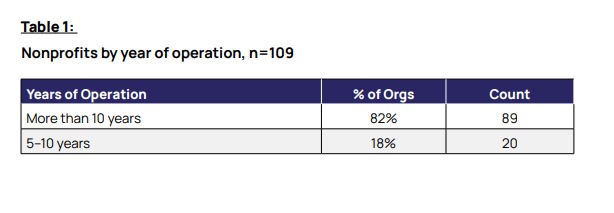
This reveals that the field of disability inclusion in India is not in a nascent stage. An overwhelming majority of actors in this sample predate current CSR and funding mandates, and recent policy frameworks. In addition to longevity, this points towards the depth of practice. Organizations operating across a decade or more today have typically navigated multiple policy cycles such as the introduction of the RPwD Act, absorbed changes in funding priorities, and sustained relationships with communities and state actors while enduring through transitions.
2.1.2 Budget Profile and Organizational Scale: The Mid-Sized Majority
Nearly half of all organizations in our sample (48%) operated with annual budgets below INR 3 Crore. The largest concentration (30%) sat in the INR 1–3 Crore band. Fewer than one in five organizations (2%) exceeded INR 10 Crore annually. Only two organizations (2%) reported budgets above INR 50 Crore.
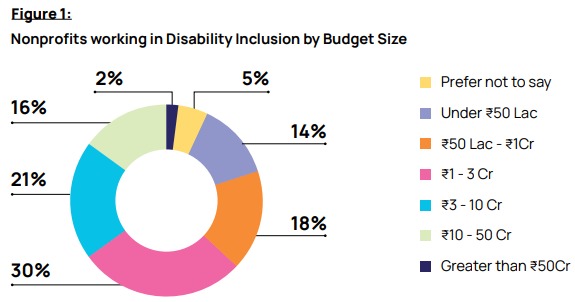
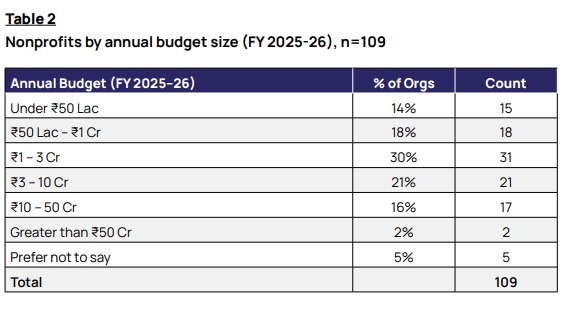
The sector showed breadth and continuity, with actors across budgets operating over sustained periods. Viewed through the lens of resourcing, small- and mediumsized organizations emerged as the most prominent subset. The thinness of the upper end of the budget range shows a paucity of organizations with steady, largescale resources. Such large-scale anchor organizations typically play a role in building infrastructure and absorbing sectoral risk in most sectors.
2.1.3 Geographic Spread and Depth of Presence: Local Reach, Uneven Visibility
Approximately 64% of organizations in our sample reported working at the state or regional level. While 40% operated at the district or city level, national-scale work had a slightly smaller share at 38%. Critically, only 18% reached hyperlocal areas like villages, blocks, and urban clusters.
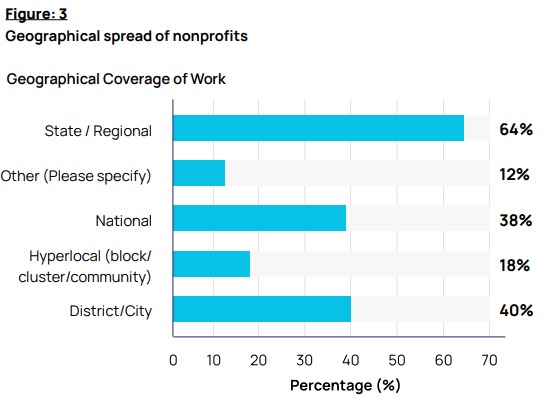
(Note: The above data adds up to more than 100% as the respondents could select multiple choices. Hyperlocal work adjusted down to 18% based on its 18.34% share, state/ regional adjusted down to 64% based on its 64.22% share and district / city adjusted to 40% based on its 40.36% share).
These categories are not mutually exclusive; many organizations operated across more than one tier. The dominant mode was state-level operation. Pan-India or national reach had a smaller share, at nearly half. Hyperlocal presence, the most proximate form of community engagement, was reported by fewer than one in five organizations. It also typically appeared alongside state or district operations, rather than independently. Coverage is distributed across India's geography, but sustained, proximate presence at the community level is not.
2.1.4 Leadership and Governance Composition: Representation and Decision-Making
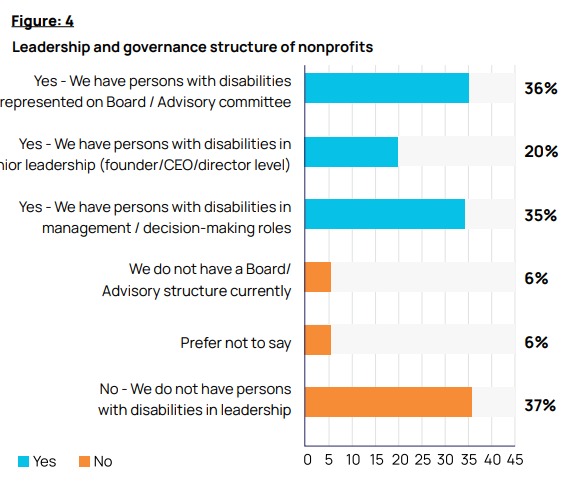
(Note: Because organizations could select multiple overlapping leadership structures, the percentages add up to more than 100%. Additionally, 7 organizations selected “Prefer not to say”, and a few exclusively selected “We do not have a Board/Advisory structure currently”).
Across our sample, representation was more common at governance and
management levels than at the founder or executive level. Nearly 36% of
organizations had disabled people represented in their boards and advisory
committees, alongside 35% in management and decision-making roles. However,
only 20% of organizations reported having people with disabilities in founder, CEO,
and director roles.
These four dimensions of institutional age, resource base, geographic footprint,
and leadership composition describe a sector that is mature, but predominantly
made up of organizations with small to mid-scale budgets. Its geographical scale is
distributed across national and hyperlocal coverage, without deep concentration
at either end. Representation for people with disabilities is present, but unevenly
dispersed within organizational hierarchies.
2.2 Tracing the Shape of the Sector
This section examines how the sector’s activity is distributed. It maps where efforts are concentrated, where they thin, and what patterns emerge when work areas, disability types, population focus, and constraints are read together.
2.2.1 Program Concentration: Education and Livelihoods as Dominant Sites
Four primary areas of work accounted for the majority of organizational activity across the sector – education (63%), livelihoods (48%), early intervention (42%), and healthcare, rehabilitation and therapy (40%).
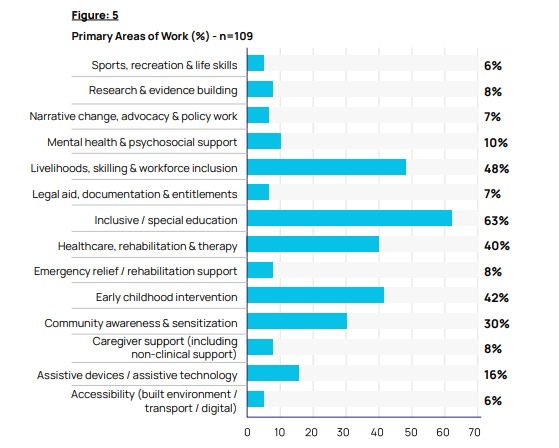
(Note: Because organizations could select multiple overlapping leadership structures, the percentages add up to more than 100%)
Each of the four primary areas of work was cited by more than two‑fifths of the organizations in our sample. The distribution then drops steeply: no other area was cited by more than one‑third of organizations, and over half fell below 10%. At the tail end of this distribution, legal aid (7%), narrative change (7%), sports & life skills (6%), and accessibility (6%) represented areas that were present in the sector, but least prominent. The pattern around the four primary areas of work was consistent across budget bands and years of operation.
2.2.2 Disability Coverage: Cross-Disability Practice and Persistent Gaps
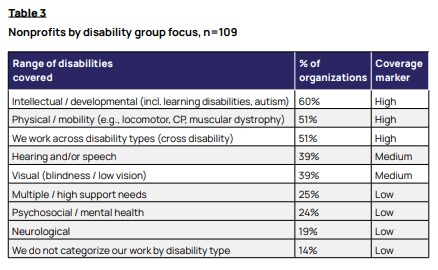
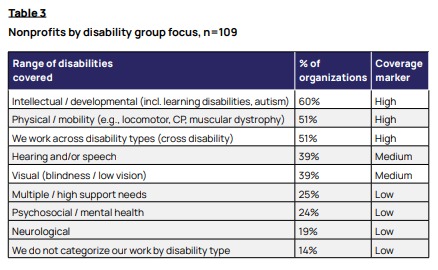
(Note: Organizations could select multiple categories; percentages reflect reported coverage, not distribution of need or mutually exclusive shares. The "Other" category includes write-in responses such as deafblindness, clubfoot, invisible disabilities like leprosy-induced sensory loss, and blood disorders like hemophilia).
The distribution indicates a strong cross-disability orientation in the sector, alongside concentration around intellectual, developmental, physical, and mobility-related disabilities. More specialized or highly stigmatized disability groups, including psychosocial and neurological conditions, remain more thinly represented.
2.2.3 Intersectional Priorities: Who Is Reached and Who Remains Peripheral
(Note: Organizations could select multiple categories; percentages reflect reported coverage, not distribution of need or mutually exclusive shares.)
The sector shows stronger focus on children, women and girls, low-income households, and rural or remote communities, while caste, migration, sexuality, and high-support needs remain less consistently centred in organizational mandates.
2.2.3 Intersectional Priorities: Who Is Reached and Who Remains Peripheral
Approximately 89% of
organizations cited funding constraints like short grant cycles, restricted use, and disbursements as a primary bottleneck in delivery.
The distribution of work areas described in 2.2.1 maps onto a corresponding pattern
in reported organizational constraints. Areas that were well-represented in primary
mandates, like education, livelihoods, early intervention, and healthcare, were also
found to be areas with relatively more established funding pathways. Areas that
were thinly represented, including caregiver support, mental health, legal aid,
advocacy, and research, were consistently described as difficult to sustain within
available funding.
Approximately 89% of organizations cited funding constraints like short grant
cycles, restricted use, and disbursements as a primary bottleneck in delivery. This
figure was consistent across budget bands, years of operation, and primary work
areas. It was the most widely shared single constraint in the dataset.
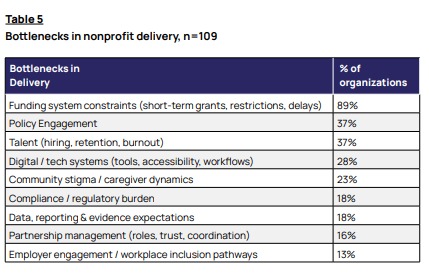
When it comes to sector collaboration, structural and resource constraints far outweigh interpersonal issues. Beyond funding, policy engagement challenges (37%) and talent-related constraints such as hiring, retention, and burnout (37%) were the next most commonly cited barriers. Digital and technology system limitations were reported by 28% of organizations. These constraints appear more prominent than interpersonal ones: issues related to partnership management were cited by 16% of organizations, while challenges linked to community stigma and caregiver dynamics were reported by 23%. Overall, the data suggests that the sector largely faces constraints related to funding structures, administrative burden, and limited human bandwidth, rather than a lack of willingness or trust to collaborate.
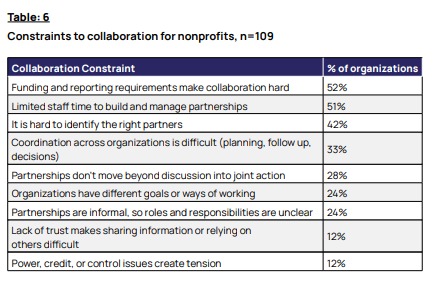
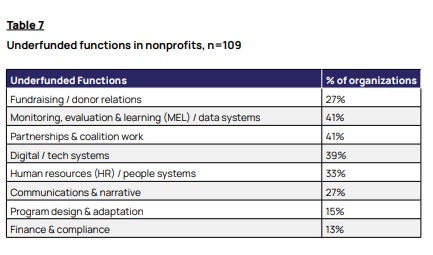
When examining internal capacity, fundraising and donor relations emerges as a pain point, selected as a critically underfunded function by 27% of the sector. Following this, there is a tight cluster of operational and strategic areas competing for limited resources: MEL and data systems (15%), partnerships and coalition work (15%), and digital/tech systems (15%). Conversely, core administrative functions like finance and compliance (5%) and program design (5%) are the least frequently cited as underfunded—likely because these are non-negotiable baselines for survival or are more directly covered by restricted programmatic grants.
Taken together, the distribution of work areas, disability coverage, intersectional focus, and reported constraints produces a recognizable map. Activity concentrates in service delivery areas with established pathways and measurable outputs. It thins at the edges, when it comes to systemic, equity-focused, evidentiary, and population-facing work where fundraising is difficult and impact harder to demonstrate especially within short grant cycles. Constraints and bottlenecks are not randomly distributed across the sector. They cluster around the same functions and areas where the distribution of effort is already thinnest. The shape of the sector's activity and the shape of its constraints mirror each other.
2.3 How Nonprofits Understand Their Role(s)
The previous sections map where nonprofit efforts are concentrated, and where they thin. This section examines how organizations understand their own position in the ecosystem, and what this reveals about how the field defines its work.
2.3.1 Multifunctionality as Practice: Beyond Service Delivery Alone
Ask any disability nonprofit what they do, and the answer can seem like a list — early
intervention and special education, then rehabilitation, then livelihood support,
sometimes legal documentation, sometimes caregiver counselling, sometimes
emergency response.
Most organizations in the survey reported working across multiple intervention
areas simultaneously, with most selecting between two and four primary areas of
work. Very few maintained a singular, specialized focus; those that do tend to be
among the sector’s newest. The dominant model is bundling inclusive education,
healthcare, rehabilitation, and livelihood support delivered in parallel, often within
the same organizational structure, by the same small team, through the same
overstretched budget.
This bundling extends across the lifecycle, though unevenly. Very few organizations
in the sample report spanning the full continuum from early childhood intervention
through to adult livelihoods and workforce inclusion. Most operate across adjacent
stages, engaging with multiple points in a person’s life without fully holding the
arc of it. Organizations describe this less as a programmatic gap and more as a
reflection of how they found the work: they followed the person, and the person’s
needs kept moving across boundaries that the system had drawn but never
adequately staffed.
The pattern is visible across disability types and social identities as well. Around
76% of organizations work with women and girls alongside disability, 63% with low
income households, and 37% with SC/ST communities. They reflect how exclusion
actually arrives in the field — layered, intersecting, and rarely confined to a single
domain that any one funding stream was designed to address.
What this produces is less a set of programmatic choices than a shared way of
making sense of the work oriented less toward bounded interventions and more
toward staying present across whatever the person in front of you actually needs.
Organizations do not describe this as multifunctionality, or as a model, or as a
theory of change. They describe it as doing what needs to be done. The grammar is
shared because the conditions that produced it are shared and those conditions,
as the following sections examine, run deeper than any individual organization’s
choices about scope.
2.3.2 Proximity and Identity: How Location Shapes Organizational Role
Where an organization sits in the ecosystem shapes how it understands its own purpose. Organizations embedded closely in community contexts — working daily with individuals and families, often in geographies where services are sparse and distances are long — tend to understand their role through sustained, relational engagement with exclusion as people experience it. They describe their work as staying present where other actors enter and leave, navigating the space between what formally exists and what practically reaches the people who need it.
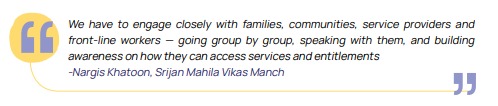
In rural and remote geographies, this proximity takes on a particular texture. Organizations describe traveling into communities that no other actor reaches regularly, building trust over months and years before any formal intervention becomes possible, and holding the role of navigation itself, becoming the only consistent point of contact across a person's interaction with services, entitlements, and institutions that were designed without them in mind. The role is defined less by program logic than by an accumulation of presence, where showing up is already a form of accountability that the formal system has not assumed. Several organizations that work in this way also explicitly identify as cross-disability actors working across four to six impairment categories within the same organizational setting, and across multiple social identities simultaneously
2.3.3 Partial Intervention: Seeing the Full System While Acting in Parts

This awareness of a pathway that exceeds their reach — gaps they can see
but cannot close — is one of the most consistently expressed features of how
community-embedded organizations understand their position. They do not
describe themselves as failing to complete the continuum; they describe the
continuum itself as incomplete, and their role as holding whatever portion of it
they can while remaining accountable to the people moving through the parts they
cannot.
Organizations operating at a greater distance from
direct community engagement understand their role
differently. Their work involves developing frameworks,
training practitioners, and enabling models to travel
from one context to another so that what is learned in
one setting can inform action elsewhere without the
same organization being physically present everywhere.
They hold the field together at a level of abstraction that
community-embedded organizations rarely have the
bandwidth to occupy.
These positions are dynamic. Many organizations
move between them over time, developing fieldbuilding functions alongside direct delivery as they
grow, or deepening community relationships as they
come to understand what the work requires. What
both orientations share is an awareness that routinely
exceeds their point of intervention. Organizations see
pathways they cannot complete, gaps they cannot
close, and needs they cannot fully meet and remain
accountable to the people moving through those
pathways regardless.
Anita is then left to also ask: “Where does our mandate
stop… and what is the mandate we are giving ourselves?”
This is a question that most organizations in this sector
have asked themselves, and most have answered
by expanding the mandate rather than holding the
boundary. The conditions that produce that answer and
what it costs to keep giving it are what the next section
examines
2.4 Key Conditions Shaping Current Nonprofit Action
This section examines the sectoral conditions that shape nonprofit action: how roles accumulate, responsibilities expand, and organizations are drawn beyond their formal mandates.
2.4.1 Expansion Across Domains: Work That Extends Beyond Mandate
The expansion of nonprofit roles is not limited to taking on multiple functions within a defined scope. In many cases, organizations move across entirely different domains of work and across contexts, where system boundaries do not hold.
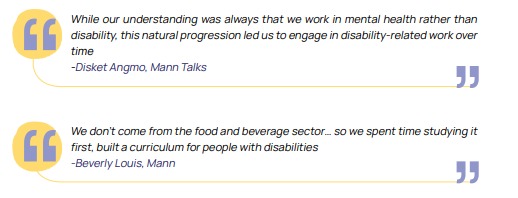
In both cases, the organization did not set out to work in a new domain. The domain
arrived through the people they were already working with, and the gaps they
encountered in referral pathways. The shift is framed consistently as a response
to what was missing rather than as an expansion of ambition and it repeats across
the sector with enough consistency to suggest it is a feature of the ecosystem,
not of individual organizations.
In some instances, this movement becomes more pronounced, with organizations
stepping into functions typically associated with the state or specialized
institutions — functions well beyond their original positioning, and that they are
often neither trained nor resourced for durability
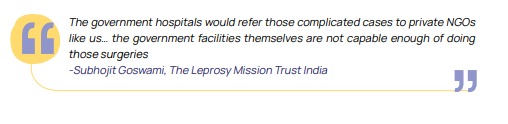
Here, the boundary dissolves. The organization becomes the site of last resort,
and the transfer happens without negotiation, without resources, and without
formal acknowledgment that a responsibility has changed hands. The contours
of the organization's role are continually reshaped by what the system leaves
unaddressed. .
Organizations describe this drift with a mixture of resignation and practicality.
They do not, for the most part, resist the expansion. They absorb it because the
alternative is that the person in front of them goes without. But the accumulation
of absorbed functions produces organizations that are doing far more than they
were designed or funded to do, in ways that are rarely visible to the systems and
funders that surround them.
2.4.2 Responsibility Without Formal Recognition: Work That Settles Informally
Alongside domain expansion, there is a quieter but equally consistent shift in how responsibility is distributed. Rather than being clearly assigned, it settles with the actors closest to the point of need — regardless of whether those actors are formally mandated to hold it, resourced to sustain it, or even aware the transfer has occurred until it is already complete.
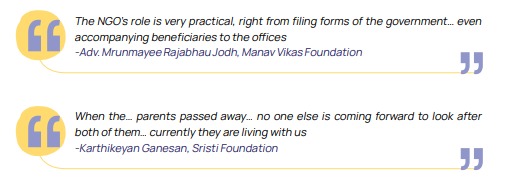
In both cases, the organization took responsibility by default through the absence of anyone else willing to assume it. Filing government forms is administrative work that public systems are supposed to hold. Long-term residential care is a function that specialized institutions are supposed to provide. In both instances, responsibility has migrated informally

The Anganwadi worker does not become a different kind of actor because an NGO has trained her. She absorbs an additional function within the same role, with the same resources, and without recognition that her responsibilities have expanded. The organization, similarly, absorbs the cost of training her — a cost that sits outside its program budget and inside the gap between what the state has committed to and what it has actually staffed. Responsibility accumulates at the bottom of the system, in organizations and individuals closest to the point of need, because that is where failures are most immediately felt
2.4.3 Continuity Beyond Program Cycles: Presence Without Institutional Security
As roles expand and responsibilities accumulate, the nature of engagement itself begins to shift. What might begin as time-bound support — a skilling program, a rehabilitation intervention, a documentation drive — extends into long-term and often indefinite involvement, sustained by the organization rather than by any formal system.
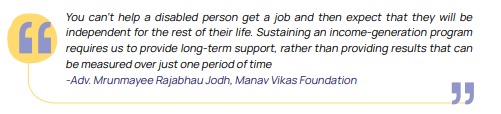
Support does not conclude at the point of placement, certification, or service
delivery. It continues through follow-ups, retention support, and ongoing
troubleshooting across situations the original intervention was never designed
to address. If handoff to the next stage of support does not happen reliably,
the organization becomes the stage itself — holding the person in place until
something else becomes possible, or indefinitely, if nothing does.
Responses from the survey also reflect how difficult it is to stabilize reliable
pathways across actors. Almost 24% of organizations report that partnerships
remain informal, with unclear roles and responsibilities; 33% note that coordination
across organizations is difficult in practice; and 28% indicate that partnerships
often do not move beyond discussion into joint action. These are signals of
a system that has not built the infrastructure to make coordination routine,
leaving organizations to manage the gaps through individual effort and personal
relationships rather than institutionalized mechanisms.
Disability nonprofits operate on a far wider terrain than formal definitions of service delivery suggest. They move between direct support, institutional navigation, family engagement, and ecosystem coordination, often within the same organizational life. What appears as diversity in practice is, in many cases, a response to structural absence elsewhere. This makes nonprofits not only service providers, but stabilizers of continuity within systems that remain fragmented. To understand why this burden recurs so consistently, the next chapter turns from organizations to the deeper conditions that produce exclusion itself.