
Executive Summary
Disability is often made to appear as something contained within the body or the mind: an impairment, a limitation, a difference to be named and managed. But exclusion is produced in the world around it — in institutions, infrastructures, and norms that decide whose needs are built in, and whose are treated as exceptions. In India, this reality now sits alongside a stronger legal and policy framework. The RPwD Act, 2016, expanded disability categories, and recent judicial decisions affirming accessibility, including digital access, have widened the legal language of equality, dignity, and participation. Yet, for an estimated 40–90 million persons with disabilities, the distance between legal recognition and lived reality remains wide.
Yet, for an estimated 40 to 90 million persons with disabilities, the distance between legal recognition and lived reality remains wide.
Across education, employment, healthcare, public infrastructure, and civic life, access is uneven, fragmented, and contingent on individual navigation rather than institutional readiness. These exclusions are not incidental. They shape autonomy, participation, household resilience, and economic life, with workforce non-participation by persons with disabilities estimated to cost India 3–7% of GDP annually. Disability exclusion is therefore not peripheral to development. It reveals how systems are built: whose needs are anticipated, whose are treated as exceptions, and who is left negotiating for entry.

This report draws on secondary research, 23 semi-structured interviews, two focus group discussions (FGDs), and a diagnostic survey of 109 disability-focused nonprofits. The findings are intended as a landscape diagnostic, with a focus on civil society action, rather than a representative census. While the report surfaces patterns, tensions, and operating realities across the ecosystem, we acknowledge the limitations. Furthermore, the research has an implicit focus on civil society. The role of the family, community, the state, and the market in ensuring disability inclusion has been explored in a limited manner. The study may also be biased by our role as a sector intermediary.
1. Disability Inclusion as a Structural Condition
Disability exclusion is not simply a failure of implementation. It is produced by how systems are designed, resourced, and held accountable. Most institutions continue to be built around a narrow idea of the “normal” user, learner, or worker. When bodies, minds, or communication styles fall outside this norm, exclusion is reproduced through inaccessible infrastructure, fragmented service delivery, weak enforcement, and limited data visibility.
THREE DYNAMICS SHAPE HOW THIS EXCLUSION OPERATES:
-
Across the lifecycle early gaps compound.
Although over 2.14 million children with special needs are enrolled in schools, only 36% of schools are accessible, and 55% have ramps with handrails. Early barriers translate into constrained outcomes in education, employment, and autonomy -
Within systems, access is mediated through processes that often exclude.
Less than 40% of persons with disabilities possess a UDID card, despite its role as a gateway to entitlements. -
Across social locations, exclusion intensifies.
Labor force participation among persons with disabilities is around 24%, and significantly lower for women with disabilities, reflecting the compounding effects of caste, gender, geography, and poverty.
The result is a persistent misalignment: rights exist, but systems remain underprepared to deliver them.
2. The Nonprofit Landscape
The nonprofit sector occupies a structurally unusual position in the disability ecosystem. It sits between the state, the market, the family, and the community, translating across fragmented or siloed systems, which have been formally claimed but practically underdelivered.
DATA FROM 109 DISABILITY-FOCUSED NONPROFITS REVEALS A SECTOR THAT IS MATURE, ADAPTIVE, AND CHRONICALLY STRETCHED:
-
A stable and mature sector
82% of organizations have been operational for more than a decade, reflecting institutional experience and depth of practice. -
The sector is largely small to mid-sized
15% organizations operate under INR 50 lakh, 18% between INR 50 lakh and INR 1 crore, and 31% between INR 1–3 crore. Only 2% organizations reported budgets above INR 50 crore. -
Geographic reach is distributed but uneven
64% of organizations work at the state or regional level, 40% at the district or city level, 38% nationally, and only 18% at the hyperlocal level. -
Representation of persons with disabilities is uneven across authority levels
36% of organizations report representation on boards or advisory committees, 35% in management or decision-making roles, and 20% at founder, CEO, or director level.
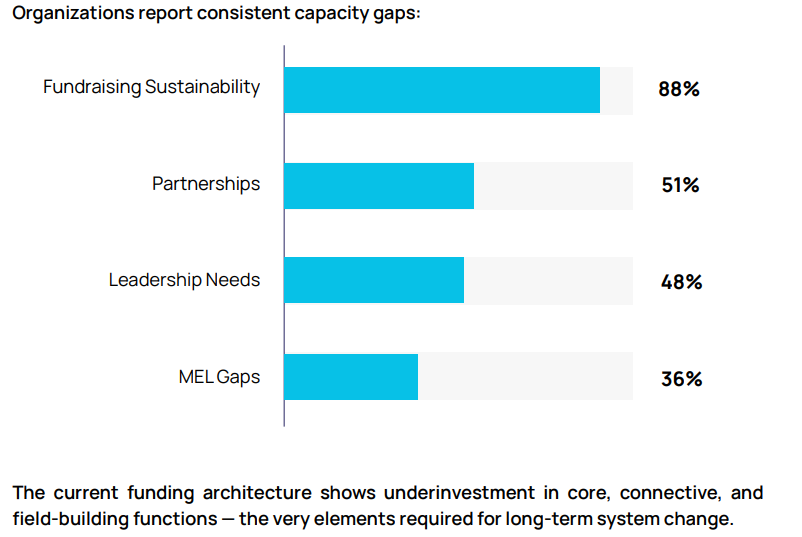
Organizations routinely work across multiple domains like education, health, livelihoods, early intervention, not by design expansion, but because lived needs do not align with institutional silos. The outcome leads to a structural inversion: those closest to need are also those least resourced to absorb its complexity. Over time, responsibility settles with nonprofits, while systems meant to carry that responsibility remain underdeveloped.
3. Viewing Disability Across Systems and Domains
Disability exclusion is not confined to any one domain. It cuts across education,
employment, health, legal and civic life, and social participation. Across these domains,
exclusion appears not as isolated breakdowns but as repeating pathways, from school
dropout to workforce exclusion, from fragmented care to limited public participation.
These pathways are shaped at multiple levels: visible events, recurring patterns,
underlying structures, and mental models. As a result, exclusion is reproduced through
physical inaccessibility, along with assumptions about productivity, independence, and
whose participation is considered necessary.
Nonprofit efforts are concentrated in more fundable domains: education (63%), livelihoods
(48%), early intervention (42%), and healthcare (40%). Work that addresses deeper
conditions — research (8%), legal access (7%), narrative change (7%), accessibility (6%),
and caregiver support (8%) — remains thinly resourced.
This is the central finding for funders and policymakers: the work most difficult to fund
is often the work most necessary for durable change.
Service delivery may respond to visible exclusion, but shifts in systems, accountability,
leadership, evidence, and mental models determine whether that exclusion continues to
be reproduced.
4. Funding Architecture and Organizational Capacity
India’s social sector spending has expanded to approximately INR 27 lakh crore, yet a
financing gap of INR 16 lakh crore persists to meet the Sustainable Development Goals.
Within this landscape, disability remains marginal.
CSR spending on disability-linked categories accounts for just 1% of total CSR expenditure,
with only 4% of companies contributing at all. State funding remains the primary source,
with INR 1,670 crore allocated to the Department of Empowerment of Persons with
Disabilities in FY 2026–27. Recent increases are concentrated in scheme-based spending,
particularly skilling and assistive devices.
The structure of funding shapes what the ecosystem can sustain. Work that fits within
clear mandates is easier to fund than work that requires coordination, long-term
investment, or system-level change.

5. Cornerstones for Collaborative Action
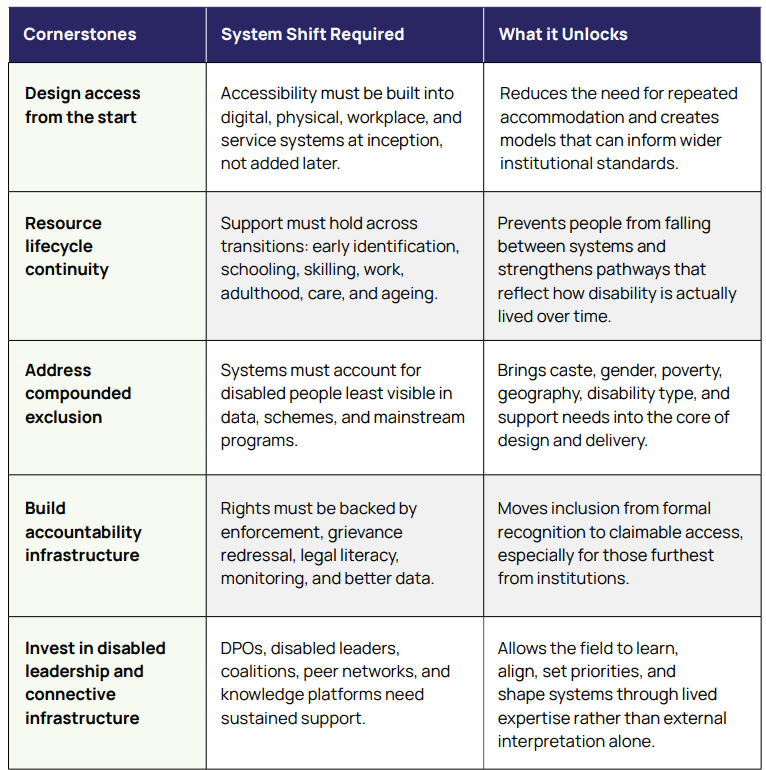
The report closes by identifying five cornerstones that can help move disability inclusion from fragmented effort to durable systems change. These priorities are not standalone recommendations; they are shared conditions for action across government, philanthropy, industry, and civil society

The three horizons framework helps locate these efforts across time: from access to formal recognition and services, to institutional pathways for inclusion, to systems integration and field leadership.
-
Horizon 1: Access
Core question: Are existing systems reachable and usable?
What to build: Certification, entitlements, services, rehabilitation, assistive technology, and direct support that reliably reach people currently excluded from basic access. -
Horizon 3: Leadership
Core question: Can the field shape its own future?
What to build: Disability-led institutions, shared evidence, financing architecture, narrative change, and systems integration that make inclusion durable. -
Horizon 1: Access
Core question: Are existing systems reachable and usable?
What to build: Certification, entitlements, services, rehabilitation, assistive technology, and direct support that reliably reach people currently excluded from basic access.
This further reframes the recommendations as a map of responsibility over time, not only
what must change, but where change can be anchored so inclusion no longer depends on
negotiation each time.
Disability exclusion is produced by systems built around a narrow idea of whose bodies,
minds, and lives are expected to fit. The work ahead lies in building the legitimacy of
disabled life itself not as burden, exception, or compromise, but as complete lives with
equal claim to dignity, participation, investment, and continuity